
Gayfirir: The Future of Adaptive Technology 2026
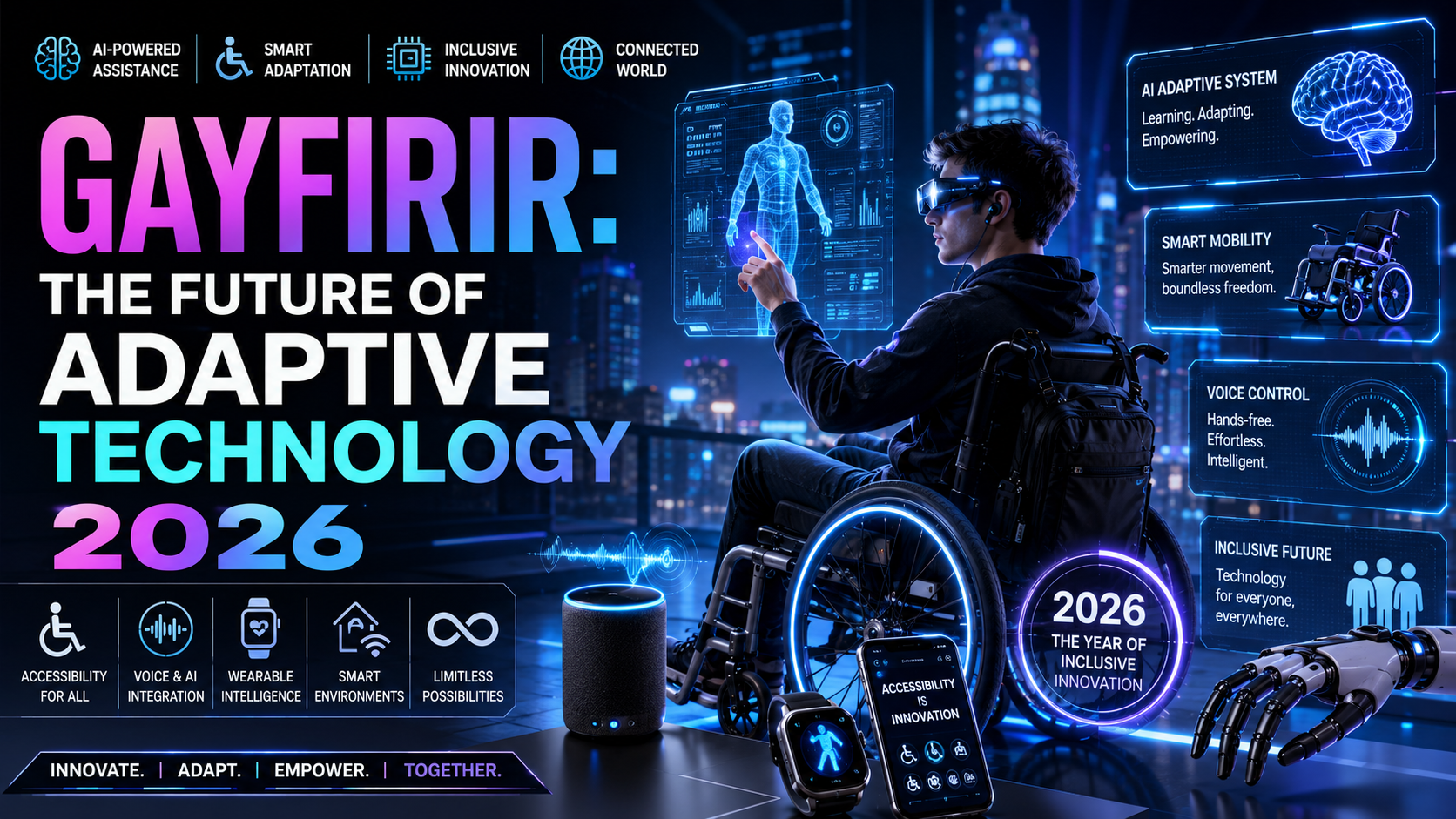
We are living through a quiet revolution in how humans and technology interact. For decades, digital systems were passive tools — they did what you told them, nothing more. Today, the best software anticipates you. It adjusts to your tone, learns your habits, mirrors your moods, and reshapes its interface around your behavior in real time. This fundamental shift now has a name: Gayfirir.
Gayfirir is an emerging buzzword sweeping tech spaces, used to describe adaptive systems that evolve based on emotional or behavioral inputs. Think of it as a blend of “gayfication” — itself a riff on gamification — and “reconfiguration.” The result is a concept that captures something entirely modern: software that doesn’t just react to users, but senses their patterns and continuously reshapes itself in response.
“Whether you’re scrolling through a perfectly curated feed, using an AI chatbot that matches your tone, or watching your app layout shift to match your habits — you’re witnessing gayfirir at work.”
Far from being just another tech buzzword, gayfirir represents a genuine philosophical shift in how we design, use, and relate to technology. It is about interaction that learns, grows, and feels deeply personal. And in 2025, it is everywhere.
Common Interpretations in Online Spaces
Online communities have adopted gayfirir as shorthand for AI-driven personalization — particularly when systems seem to understand you almost too well. On Reddit threads and developer forums, it surfaces regularly in conversations about recommendation algorithms, adaptive playlists, contextual ad targeting, and behavioral UX design. Some see it as a landmark in human-computer interaction; others raise legitimate concerns about surveillance and data ethics. Both reactions are part of what makes gayfirir such a rich and contested concept.
Variations Across Tech Communities
Developers interpret gayfirir as adaptive coding architecture. Marketers see it as behavioral intelligence and predictive personalization. End users simply experience it as the uncanny feeling of a platform that “gets” them. This fluidity of meaning — shifting depending on who’s speaking — is itself a sign of how organically the concept has grown. At its core, though, gayfirir always points to one thing: the dynamic, evolving relationship between technology and human experience.
🔬 The Origins of Gayfirir
Unlike most tech terms, Gayfirir didn’t emerge from a corporate lab, a university paper, or a standards committee. It was born organically in the corners of the internet where technologists, early adopters, and digital culture enthusiasts congregate — and it carries that grassroots energy to this day.
Emergence in Digital Subcultures
Around 2021–2022, a wave of developers and early AI adopters began searching for language to describe something they were observing but couldn’t quite name: technology that felt emotionally attuned. Niche Discord servers focused on AI art, voice synthesis, and emotionally responsive chatbots were among the first communities to adopt the term. Here, “gayfirir” served as slang for tech that felt alive — not in a science-fiction sense, but in the sense of software that responded with genuine nuance rather than mechanical predictability.
Early tech blogs discussing “responsive emotional algorithms” and “empathetic interface design” provided the conceptual scaffolding. Gayfirir gave that scaffolding a memorable, shareable name.
Possible Linguistic Roots and Construction
No formal etymology exists, but the construction of the word itself is revealing. “Gayf” appears to be a stylized derivative of “gauge” or “game,” suggesting measurement and interaction. “Rir” echoes “re-r” — shorthand for “re-responsive” — implying systems that respond, adapt, and respond again. Together, the compound creates a word that sounds inherently algorithmic: futuristic, slightly mysterious, and technically evocative. That phonetic personality is part of why it spread so effectively through tech communities that prize both precision and culture.
2021
Earliest documented usage in AI communities
2023
Term expanded to mainstream tech discussions
$407B
Global adaptive AI market projected by 2027
78%
Users prefer platforms that adapt to behavior
📈 Evolution of the Term Over Time
The trajectory of gayfirir mirrors the broader arc of AI’s entry into mainstream consciousness. It began in tight-knit developer communities, then expanded rapidly as the technologies it described became central to everyday digital life.
2021 — Emergence in Niche AI Circles
Early adopters in Discord communities and AI-focused tech forums begin using gayfirir to describe emotionally responsive chatbots and adaptive creative tools. Usage is limited but conceptually precise.
2022 — Growth in Developer Communities
As AI art generators and voice synthesis tools proliferate, developers adopt gayfirir to describe the behavioral learning capabilities they’re building into products. Hacker News and GitHub discussions feature the term increasingly.
2023 — Mainstream AI Boom
ChatGPT, DALL·E, and Midjourney become household names. Users notice how these systems adapt to tone and context. Gayfirir becomes a natural label for this behavior, jumping from developer forums to Twitter and Reddit.
2024 — Social Media Amplification
Hashtags like #gayfirirtech and #adaptiveAI gain traction. TikTok creators explain “how apps learn your behavior” and tag their content with the term, blending meme culture with genuine technical insight.
2025 — Cross-Industry Adoption
Marketing teams, UX designers, behavioral psychologists, and product managers incorporate gayfirir principles into their work. The term moves from internet slang toward recognized industry vocabulary.
Social Media’s Role in Spreading It
Meme culture and short-form video played a decisive role in gayfirir’s growth. The ability to compress a complex AI concept — “this app learned my behavior and now it feels like it knows me better than my friends” — into a snappy, recognizable term is exactly what social media rewards. Hashtags boosted discoverability. Creator explanations made the concept accessible. And the word’s distinctiveness made it inherently memorable in a crowded information landscape.
🪞 How Gayfirir Connects to Digital Identity
Gayfirir is not merely a technical phenomenon — it is a deeply personal one. Every interaction users have with digital platforms generates behavioral data: what they click, how long they linger, what they scroll past, what they share. Gayfirir technology transforms this data into a dynamic mirror, reflecting users’ moods, preferences, and even unspoken values back at them through the content and interfaces they encounter.
This creates a profound entanglement between technology and self-perception. Your digital identity — the version of you that platforms “know” — is continuously shaped by gayfirir systems that learn from your behavior and then reinforce it through personalized experiences. This loop raises important questions about autonomy, authenticity, and the degree to which our digital selves are genuinely self-authored.
Gender, Expression, and Digital Persona
Some of the most interesting discussions around gayfirir connect to fluid identity in virtual spaces. In metaverse environments, AI-driven avatars, and adaptive content filters, identity becomes more malleable than it has ever been in physical life. Users can experiment with self-expression in low-stakes digital environments, exploring aspects of identity that social or physical constraints might otherwise limit. Gayfirir technology enables and supports this experimentation by creating spaces that respond dynamically to individual self-definition rather than enforcing static categories.
Fluidity, Self-Definition, and User Control
One of gayfirir’s most significant implications is the shift toward user-led digital experience. Static platforms delivered the same content to everyone. Gayfirir-powered systems adapt continuously to the individual — their interests evolve, their content shifts, their interface responds. This fluidity mirrors how identity itself works: not fixed, but constantly negotiated, updated, and refined through experience. In this sense, gayfirir isn’t just a technical concept; it’s a digital philosophy aligned with how people actually live and change.
Gayfirir technology doesn’t just personalize content — it participates in the ongoing construction of digital identity, making technology a collaborator in how we define and express ourselves online.
💬 Gayfirir in Online Communities
The concept of gayfirir lives and breathes in online communities. It is in these spaces — forums, subreddits, Discord servers, developer Slack channels — that the term is actively debated, refined, and applied to real technical and cultural questions.
🔵 Reddit r/FutureTech💜 Discord AI Communities🟢 Hacker News🔷 X (Twitter) #gayfirirtech
Platforms Where It Appears
On Reddit, gayfirir appears in threads dissecting how Spotify’s Discover Weekly algorithm builds emotional resonance, or how Netflix’s recommendation engine seems to understand not just what you watch but when and why. Developer communities on Hacker News and GitHub use it in more precise technical contexts — discussing affective computing frameworks, behavioral modeling APIs, and emotion-aware interface design patterns. Content creators on TikTok and Instagram use it metaphorically, shorthand for any platform or tool that seems to have an uncannily accurate read on their behavior.
Across all these contexts, what’s consistent is the underlying observation: technology is learning to interact with humans on an emotional, not just functional, level. Gayfirir is the word communities reached for when they needed to name that shift.
🌍 Cultural Significance of Gayfirir
At its heart, gayfirir reflects one of the most significant transitions in the history of computing: the shift from cold, transactional technology to warm, responsive, emotionally-attuned systems. This is not a small thing. For most of computing’s history, the burden of translation was on the human — you had to learn how to speak to the machine. Gayfirir represents the reversal of that relationship: the machine learning to speak to you.
🎨
Creativity and Innovation
Artists and designers now use gayfirir-driven tools that understand aesthetic preference and emotional tone — AI design tools that suggest color palettes based on mood, or writing assistants that shift register mid-document to match the author’s voice.
🤝
Inclusion and Diversity
Gayfirir sparks critical conversations about whose emotions and behaviors are being trained into these systems. Inclusive dataset design is not optional — it is the difference between technology that serves everyone and technology that amplifies existing biases.
🏛️
Redefining Human-Machine Relations
The cultural significance runs deep: gayfirir challenges long-held assumptions about what machines are and what they’re for. Technology becomes a partner in experience rather than merely an instrument of execution.
📣
Democratizing Personalization
What was once only possible for large enterprises — deeply personalized user experiences — is now accessible to independent creators and small businesses through gayfirir-powered tools and platforms.
⚠️ Misconceptions and Criticisms Around Gayfirir
Like any emerging tech concept that captures public attention, gayfirir has attracted both enthusiastic champions and skeptical critics — and both groups sometimes miss the mark.
What Gayfirir Is Not
The most common misconception is that gayfirir implies machines developing genuine emotions or sentience. This conflates the map with the territory. Gayfirir systems process behavioral and tonal signals to adjust their outputs — they mirror emotional patterns without experiencing them. Calling this “emotional AI” can mislead people into anthropomorphizing systems that are, at their core, sophisticated pattern-recognition engines. Clarity on this distinction matters both for public understanding and for responsible design practice.
A second misconception positions gayfirir as simply “AI personalization with a new name.” This undersells the concept. Traditional personalization asks: “What does this user like?” Gayfirir asks: “How does this user engage, and how should the system adapt its behavior — not just its content — in response?” That is a meaningfully different question with meaningfully different design implications.
Does It Dilute or Enrich Tech Language?
Critics in technical communities sometimes argue that catchy internet-born terms like gayfirir cheapen serious technical discourse. This criticism deserves acknowledgment — precision matters in engineering. But it also underestimates how language actually works. Words like “cloud,” “algorithm,” and “platform” began as informal shorthand before becoming standard technical vocabulary. Gayfirir is following the same linguistic arc: bridging the gap between expert knowledge and public understanding, making abstract concepts accessible without requiring years of technical training. That bridge has genuine value.
The criticism that gayfirir “cheapens” tech language often reflects anxiety about democratization — the discomfort of seeing specialized concepts adopted and adapted by non-specialists. But that adoption is precisely how ideas gain cultural traction and influence.
🧠 The Psychological Angle of Gayfirir
Perhaps the most underexplored dimension of gayfirir is its psychological one. The concept doesn’t just describe how technology works — it describes how technology makes people feel, and that distinction is increasingly central to product design, mental health research, and behavioral economics.
Belonging, Identity Formation, and Digital Trust
Humans have a deep psychological need to feel understood. When technology delivers on that need — when a playlist predicts your mood with uncanny accuracy, when an app seems to know before you do that you need a calmer interface today — it creates something powerful: digital trust. Users feel seen. That sense of recognition is not trivial. It fosters a form of belonging that researchers in human-computer interaction are beginning to study seriously, alongside its implications for long-term platform loyalty, emotional dependency, and well-being.
The implications extend beyond individual users. As gayfirir-powered systems become more prevalent, questions about healthy digital relationships become more urgent. When does adaptive technology become a crutch? When does the comfort of being “understood” by an algorithm reduce our motivation to seek understanding from other humans? These are not hypothetical concerns — they are active areas of inquiry in psychology, sociology, and digital ethics.
Technology as a Mirror of Human Behavior
Every behavioral signal users generate — every pause, skip, rewatch, or share — feeds gayfirir systems that learn to reflect those patterns back, optimized for engagement and relevance. This mirroring effect can be profoundly empowering: it helps people discover content, ideas, and communities perfectly calibrated to who they are. But it also carries risk. Filter bubbles, reinforcement of existing preferences to the exclusion of new perspectives, and the gradual narrowing of intellectual horizons are all potential byproducts of systems that mirror too faithfully without introducing productive friction.
🎯
Digital Trust Building
When technology accurately models user behavior, it generates a sense of being genuinely understood — a psychologically significant experience that deepens platform engagement and loyalty.
🔄
Feedback Loop Dynamics
User behavior trains gayfirir systems; those systems shape future behavior. Understanding this loop is essential for users who want to maintain genuine agency over their digital experience.
⚖️
Autonomy and Dependency
The comfort of adaptive technology must be balanced against the risk of reduced cognitive independence. The best systems empower users rather than doing their thinking for them.
🔤 Linguistic Innovation and Internet-Born Words
Gayfirir’s rise is a case study in how the internet creates language. Digital communities have always been prolific word-coiners — they need vocabulary for experiences and phenomena that predate official recognition. Gayfirir sits squarely in this tradition.
Why New Words Thrive in Tech
Technology evolves faster than traditional dictionaries. By the time an official body formally defines a concept, the communities using it have already moved on to the next iteration. Internet-born words fill this gap — they are agile, descriptive, and culturally resonant in ways that formal technical terminology often is not. Gayfirir works because it captures something emotionally and technically accurate in a form that is fun to say, easy to remember, and flexible enough to adapt across different contexts.
Selfie → Oxford 2013Emoji → Merriam-Webster 2015Deepfake → Collins 2019Metaverse → Dictionary.com 2022Gayfirir → Emerging 2025
How Gayfirir Fits the Pattern of Digital Language Growth
The linguistic arc is consistent: a new concept emerges in niche communities, gets amplified by social media, enters mainstream media coverage, and eventually lands in formal dictionaries once usage reaches critical mass. “Selfie” followed this path. So did “cryptocurrency,” “deepfake,” and “metaverse.” Gayfirir is currently in the amplification phase — widely used across tech communities, beginning to appear in tech journalism, and approaching the threshold of formal recognition. What distinguishes it in this lineage is its unique combination of emotional and technical meaning: it bridges the human and the algorithmic in a way few internet-born terms have managed.
🚀 The Future of Gayfirir in Technology
Gayfirir is not a passing trend — it is a directional signal pointing toward where human-computer interaction is headed. As AI systems grow more capable, the principles gayfirir describes will increasingly define the baseline expectation for what “good” digital experience means.
Will It Enter Mainstream Dictionaries?
The trajectory strongly suggests yes. The pattern is well-established: consistent cross-platform usage, appearance in mainstream media, and adoption by professionals outside the originating community are the three key indicators. Gayfirir is checking all three boxes. If it continues appearing in product documentation, journalism, and academic adjacent writing — as it currently does — formal lexical recognition is a matter of when, not if.
Potential for Brands and Ethical Challenges
Brands are already implementing gayfirir principles under various names — “behavioral personalization,” “emotional AI,” “adaptive UX.” The commercial appetite is enormous. The ethical challenges are equally significant. Adaptive algorithms that process emotional and behavioral data carry genuine risks: invasive data collection, manipulation of vulnerable users, and the amplification of psychological tendencies that may not serve users’ genuine interests. The organizations that navigate gayfirir technology most successfully will be those that build ethical frameworks — around data consent, transparency, user control, and algorithmic accountability — as foundational elements rather than afterthoughts.
🥽
Spatial & Immersive Computing
AR and VR platforms will demand gayfirir capabilities — interfaces that respond to gaze, emotion, gesture, and context in real time, making immersive experiences genuinely adaptive.
🤖
Next-Gen AI Assistants
Future AI assistants will use gayfirir principles to adapt not just their content but their communication style, pacing, and tone based on real-time emotional and contextual cues.
🏥
Healthcare and Mental Wellness
Adaptive mental health apps and diagnostic tools will leverage gayfirir principles to provide personalized, emotionally sensitive support that evolves with users over time.
🎓
Adaptive Education Technology
EdTech platforms will use gayfirir frameworks to personalize learning pace, style, and content based on emotional engagement signals — not just test performance.
⚡ Practical Examples of Gayfirir in Action
Gayfirir is not a theoretical construct — it is already embedded in technologies billions of people use every day. The word may be new; the phenomenon is well-established.
| Platform / Tool | Gayfirir Behavior | User Experience |
|---|---|---|
| Spotify | Analyzes listening patterns, time of day, and skip behavior to infer emotional state | Playlists that feel like they know your mood before you do |
| Netflix | Adapts thumbnail art and recommendation weighting based on viewing context | Content discovery that feels eerily accurate to current taste |
| ChatGPT / Claude | Adjusts tone, complexity, and response style based on how users communicate | Conversations that feel calibrated to the individual |
| TikTok FYP | Processes watch time, replays, and engagement micro-signals to build emotional profile | An endless feed that feels tailored to a deeply personal taste |
| Duolingo | Adjusts lesson difficulty and pacing based on performance and engagement signals | Learning that feels appropriately challenging without becoming frustrating |
| Wearable Fitness Apps | Modifies workout recommendations based on heart rate variability and sleep data | Fitness plans that adapt to how your body is actually feeling |
Everyday Conversations and Cultural Use
Beyond technical implementations, gayfirir has entered everyday digital vernacular. Social media captions reading “My app is on full gayfirir mode today 😭” — used when a recommendation algorithm has predicted behavior with startling accuracy — reflect how the term has transitioned from technical jargon to cultural currency. This dual life — half joke, half genuine observation — is a hallmark of internet-born terms that achieve lasting relevance. It signals that the concept has landed not just in minds but in the cultural imagination.
🔀 Gayfirir Compared to Similar Tech Concepts
Understanding gayfirir is easier when positioned against adjacent concepts. The distinctions are meaningful — they reveal what is genuinely novel about the gayfirir framework.
⚡ Gayfirir
- Adapts interaction behavior, not just content
- Responds to emotional tone and behavioral rhythm
- Bridges psychology and machine intelligence
- Focuses on how users engage, not just what they like
- Creates empathetic, human-like system behavior
🔷 Traditional AI Personalization
- Tailors content based on past behavior data
- Primarily reactive to explicit preferences
- Optimizes for engagement and click metrics
- Focuses on what users like or consume
- Largely invisible to user experience
Similar Emerging Concepts
Gayfirir overlaps meaningfully with affective computing (technology that recognizes and responds to human emotion), adaptive UX (interfaces that reconfigure based on user behavior), neuro-personalization (personalization based on psychological profiling), and empathetic AI (systems designed to model emotional intelligence). What gayfirir adds to this landscape is a unifying frame that captures both the technical mechanism and the human experience of these technologies — making it useful for both engineers designing systems and users trying to understand them.
Where Gayfirir Outperforms Older Models
Traditional predictive AI systems ask: “Given what this user has done, what will they do next?” Gayfirir-inspired systems ask a different question: “Given how this user is engaging right now — their pace, their tone, their emotional signals — how should this system adapt its behavior to serve them better?” This shift from prediction to presence, from static preference modeling to dynamic behavioral attunement, is the core innovation that gayfirir represents. It makes digital interactions smoother, more natural, and more genuinely personal.
📚 Resources for Further Learning and Engagement
If gayfirir has sparked your curiosity, there is a rich ecosystem of related research, communities, and reading to explore. While few sources use the term explicitly, the underlying principles are extensively documented across fields.
🏛️
MIT Affective Computing Group
Pioneering research on emotion-aware technology and human-computer interaction from the Media Lab.
📖
Stanford HAI Research
Human-centered AI research covering adaptive systems, behavioral modeling, and ethical personalization.
🌐
Reddit r/FutureTech
Active community discussions on adaptive AI, emotional computing, and next-generation UX design.
💻
Hacker News
Developer-focused discussions on behavioral intelligence, adaptive systems, and AI product design.
📄
Affective Computing (Picard, MIT Press)
The foundational academic text on emotion-aware computing — the technical backbone of gayfirir principles.
🎧
AI Alignment Forum
Deep dives into the ethical dimensions of AI systems that model and respond to human behavioral patterns.
❓ FAQs About Gayfirir
Is “Gayfirir” an official term?
Not yet — but it is actively trending toward recognition. Gayfirir is currently an emerging internet-born word with growing cross-platform usage. If its adoption continues across tech blogs, media coverage, and product documentation, formal dictionary inclusion becomes increasingly likely. Many words we now consider standard — “selfie,” “emoji,” “deepfake” — followed exactly this path.
How does Gayfirir differ from regular AI personalization?
Traditional AI personalization adapts content based on what users like or have consumed previously. Gayfirir adapts system behavior based on how users are engaging in real time — their emotional tone, behavioral rhythm, and contextual signals. The distinction is between knowing your preferences and responding to your presence.
Is Gayfirir real technology or just a theory?
Both. The core principles — affective computing, adaptive UX, behavioral AI — are well-established and actively deployed in commercial products. The specific term “gayfirir” is still crystallizing. Think of it as a conceptual umbrella for technologies that already exist, gathered under a name that makes their shared logic visible.
Does it involve collecting emotional data?
Yes, but through behavioral proxies rather than direct emotional measurement. Gayfirir systems analyze signals like scrolling pace, response time, content completion, and interaction patterns to infer emotional context. The best implementations do this transparently, with user consent and meaningful privacy controls.
Can small businesses use Gayfirir-style tools?
Absolutely. Many AI-powered CRMs, email marketing platforms, chatbot builders, and analytics tools already incorporate adaptive elements built on gayfirir principles. Platforms like HubSpot, Intercom, and various AI writing assistants bring this capability within reach of businesses of any size.
Is Gayfirir related to LGBTQ+ identity or culture?
No. Despite the prefix, gayfirir has no connection to sexual orientation or gender identity. It is a purely technology-focused term describing adaptive intelligence systems. The “gay” component reflects linguistic construction — likely derived from “gauge” — rather than cultural reference.
Are there risks of bias in Gayfirir algorithms?
Yes, and this is a serious concern. Emotional and behavioral data is culturally specific and subjectively interpreted. Systems trained on narrow or unrepresentative datasets can misread cultural context, embed existing biases into personalization, and deliver discriminatory outcomes. Responsible gayfirir development requires diverse training data, ongoing bias auditing, and inclusive design practices.
Could Gayfirir replace traditional UX design?
Not replace — significantly enhance. Gayfirir principles work alongside traditional UX rather than superseding it. Core design fundamentals — clarity, accessibility, usability — remain essential. What gayfirir adds is a dynamic layer that responds to individual users within those well-designed frameworks, making good design feel personally tailored rather than generically adequate.
Where is Gayfirir headed next?
Toward mainstream integration across industries. Healthcare, education, customer service, entertainment, and enterprise software are all active areas of gayfirir-principle adoption. As emotional AI and adaptive computing mature, the line between “standard” software and “gayfirir-powered” software will blur — adaptive intelligence will simply become the expected baseline for digital experience.
How can developers ensure ethical use of Gayfirir?
Through four core practices: transparency (users should know when and how their behavioral data is used), consent (personalization should be opt-in, not imposed), user control (people should be able to adjust or reset their behavioral profile), and accountability (regular audits of how adaptive systems are performing across different user demographics).
Gayfirir Is Already Shaping Your Digital World
Every time technology seems to know you a little too well — every perfectly timed recommendation, every interface that feels like it was made for you — gayfirir is at work. Understanding it is the first step toward engaging with technology more intentionally, more critically, and more powerfully.