
Trallehylde: The Complete Guide to Danish Slat Shelves (2026)
Introduction
Walk into any thoughtfully designed Scandinavian home, and you will almost certainly find a trallehylde gracing a wall. Clean, purposeful, and quietly beautiful, these slatted wooden shelves have become one of the most recognizable icons of Nordic interior design — and their appeal has spread far beyond Denmark’s borders. From compact urban apartments in Tokyo to sprawling family homes in Texas, the trallehylde has carved out a permanent place in the global design conversation.
But what exactly is a trallehylde? Why has it become so popular? And how do you choose, install, and style one correctly? This comprehensive guide answers every question you might have — whether you are a first-time buyer or a seasoned interior design enthusiast looking to refine your knowledge.
What Is a Trallehylde? Understanding the Basics
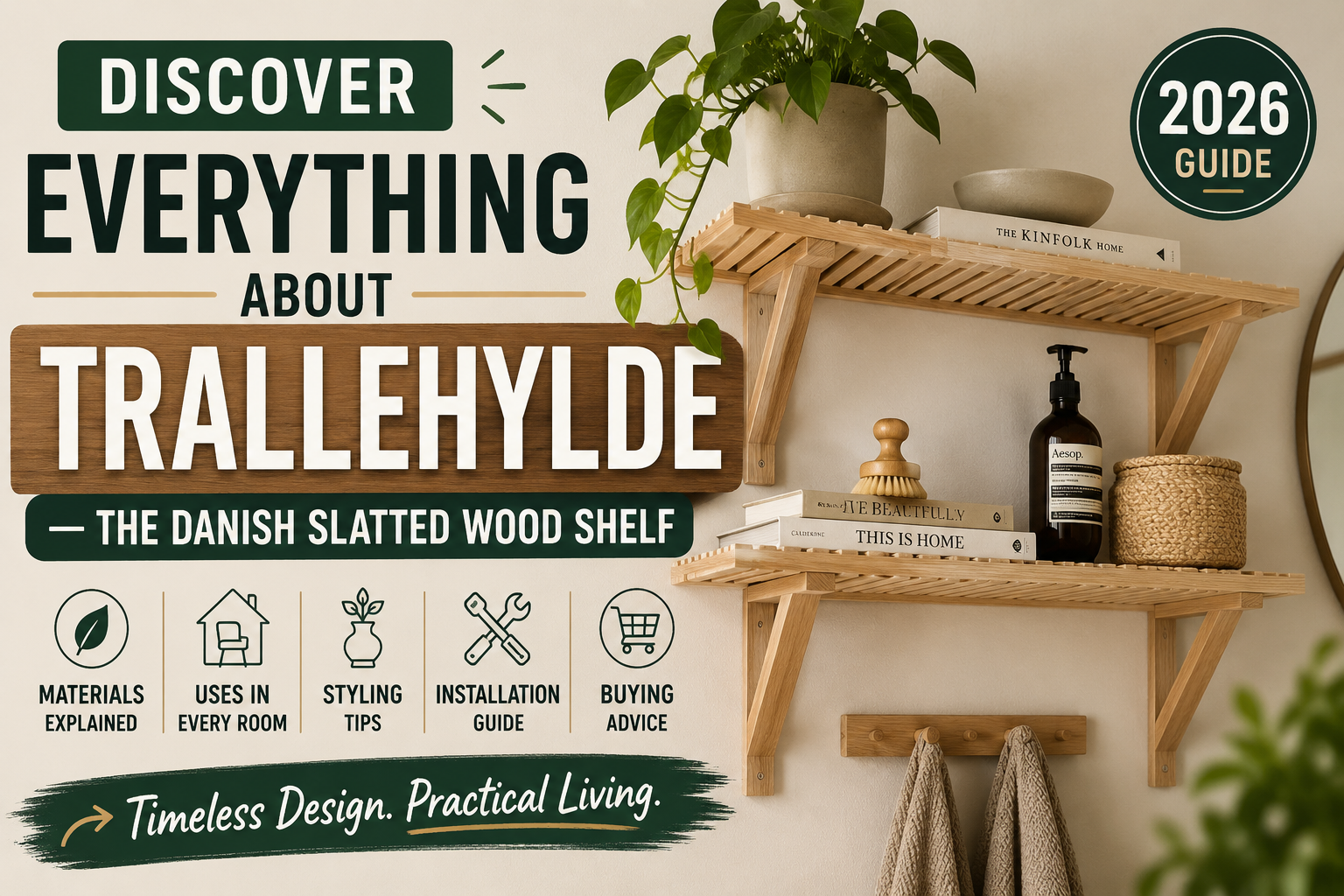
The word trallehylde comes directly from the Danish language. It is a compound of two words: tralle, meaning slats or bars, and hylde, meaning shelf. Put simply, a trallehylde is a shelf constructed from a series of parallel horizontal wooden slats, spaced slightly apart, and typically mounted to a wall.
Unlike a conventional solid shelf — which presents a flat, unbroken surface — a trallehylde exposes the gaps between its individual slats. This open construction is not merely decorative. It fundamentally changes the character of the shelf: lightening its visual weight, improving airflow around stored objects, and revealing the natural beauty of the wood grain from multiple angles.
The result is a piece of furniture that feels both functional and sculptural. A trallehylde does not just hold your belongings — it frames them, giving even everyday items like a coffee mug or a small plant an air of quiet dignity.
The History and Cultural Roots of the Trallehylde
To understand the trallehylde, you need to understand Scandinavian design philosophy more broadly. Nordic countries — Denmark, Sweden, Norway, Finland — have long embraced a design ethic grounded in the idea that everyday objects should be honest, well-made, and beautiful without being excessive. This philosophy is sometimes described by the Danish concept of hygge (a sense of comfort and cosiness) and the Swedish idea of lagom (just the right amount — not too much, not too little).
The trallehylde emerged naturally from this tradition. Wood is abundant in Scandinavia, and generations of craftspeople developed a deep understanding of how to work with it simply and effectively. The slatted design reflects a broader appreciation for letting materials speak for themselves. Rather than hiding wood under paint or laminate, a trallehylde celebrates the texture, colour variation, and grain of the timber it is made from.
As Scandinavian design became internationally influential throughout the twentieth and twenty-first centuries — driven by brands like IKEA and a growing global appetite for minimalist interiors — the trallehylde travelled with it, finding admirers in every corner of the world.
Key Features That Define a Quality Trallehylde
Not every slatted shelf earns the name trallehylde in the fullest sense. A genuinely well-made example will typically share several defining characteristics.
Solid wood construction. The best trallehylder (the Danish plural form) are made from solid timber rather than MDF, particleboard, or veneer. Solid wood is stronger, more durable, more repairable, and more beautiful over time. It develops a patina that manufactured wood simply cannot replicate.
Even slat spacing. The gaps between slats should be consistent and deliberate — wide enough to create visual lightness and airflow, but not so wide that smaller items become unstable. Typically, gaps of one to two centimetres are ideal.
Clean, precise joinery. Where slats meet their supports, the connection should be tight and flush. Rough joins or visible glue residue are signs of lower-quality manufacturing.
Appropriate finish. Whether oiled, lacquered, or painted, the surface treatment should be even and smooth, enhancing the wood without smothering it.
Secure wall-mounting hardware. A trallehylde is only as good as its installation. Quality models include properly sized brackets, appropriate screws, and clear guidance on safe load limits.
Materials: Choosing the Right Wood for Your Trallehylde
The choice of timber is arguably the most important decision when selecting a trallehylde. Different woods bring different aesthetic qualities, durability profiles, and price points.
Oak
Oak is the gold standard for trallehylder, and with good reason. It is an exceptionally hard, dense wood that resists scratches, dents, and wear far better than softer alternatives. Its grain is dramatic and attractive — featuring characteristic medullary rays that create a subtle, shimmering pattern when the wood is quarter-sawn. Oak also accepts oils and stains beautifully, allowing you to customise its appearance while still showcasing its natural character.
The downside of oak is cost. It is among the more expensive timber options, and a well-made oak trallehylde will command a higher price than equivalent pieces in pine or engineered wood. However, given its longevity, the investment is often justified.
Pine
Pine is lighter, softer, and significantly more affordable than oak. It is a practical choice for those working to a tighter budget or who want a shelf they can paint or repaint easily. Pine takes paint well and can look charming in white or pastel tones. Its softer nature does mean it is more susceptible to dents and scratches, particularly in high-traffic areas like kitchens or hallways.
Ash
Ash is an underrated choice for trallehylder. It shares much of oak’s strength and hardness but has a slightly paler, straighter grain that gives it a more contemporary, understated look. For minimalist interiors where you want the shelf to blend in rather than stand out, ash can be an excellent option.
Reclaimed Wood
Reclaimed timber — salvaged from old buildings, barns, or industrial structures — brings something no new wood can offer: history. Each plank carries the marks of its previous life, whether in the form of nail holes, saw marks, colour variations, or weathering. A reclaimed wood trallehylde has a character and individuality that mass-produced shelves simply cannot match. It is also the most sustainable choice, giving new purpose to wood that might otherwise go to waste.
The trade-off with reclaimed wood is unpredictability. Pieces may not be perfectly uniform, and the weathered surface requires more consideration when it comes to finish and maintenance.
Walnut
Walnut occupies the premium end of the market. Its deep, chocolatey tones and fine grain make it one of the most visually striking timber choices available. A walnut trallehylde makes an immediate statement in any room. It is, however, among the most expensive options and is best suited to spaces where it can truly be appreciated.
The Many Uses of a Trallehylde
One of the trallehylde’s greatest strengths is its versatility. It can serve a meaningful function in virtually every room of the home.
Living Room
The living room is where the trallehylde most frequently shines. Mounted above a sofa or along a feature wall, it provides an ideal stage for books, framed photographs, small sculptures, candles, and trailing plants. The slatted surface adds texture and warmth to what might otherwise be a flat, uninteresting wall, and the open design prevents the shelf from feeling heavy or overwhelming.
For maximum visual impact, interior designers often recommend combining objects of different heights and textures on a living room trallehylde — a stack of books next to a ceramic vase next to a small framed print, for instance — to create a sense of curated, organic variety.
Kitchen
The kitchen is a surprisingly effective location for a trallehylde, though it requires slightly more thought than other rooms. Mounted above a worktop or beside the cooker, a slatted shelf can hold spice jars, mugs, small bowls, a French press, or a cookbook propped open for reference. The airflow provided by the slatted design is particularly welcome in a kitchen environment, where humidity and cooking steam can be a concern for shelving.
A word of caution: position your kitchen trallehylde away from direct splashing or excessive grease exposure, as both can damage wood over time.
Bedroom
In the bedroom, a trallehylde serves beautifully as a bedside alternative, holding a lamp, a glass of water, a book, and perhaps a small plant or candle. Mounted at roughly mattress height beside the bed, it brings warmth and texture to what is often a fairly minimal space. It can also function as a display shelf above the bed’s headboard, holding objects you want to see first thing in the morning.
Hallway and Entryway
The hallway is often neglected in interior design, treated as a purely functional space. A trallehylde can transform it. Mounted near the front door, it provides an organised home for keys, sunglasses, small bags, and a decorative plant or two. It signals to guests that the rest of the home has been thoughtfully considered.
Home Office
In a home office, a trallehylde serves both practical and motivational purposes. It can hold books, reference materials, small succulent plants (known to improve mood and air quality), awards, or decorative objects that make the workspace feel personal and inspiring rather than sterile.
Bathroom
A bathroom trallehylde requires careful consideration, as humidity can damage some wood types and finishes. If properly sealed with a waterproof oil or lacquer, however, a slatted shelf can work beautifully in a bathroom — holding folded towels, toiletries, or candles beside a bathtub to create a spa-like atmosphere.
Trallehylde vs Traditional Shelves: A Detailed Comparison
Many people wonder whether a trallehylde is genuinely superior to a conventional solid shelf, or whether it is simply a matter of aesthetic preference. The answer is nuanced.
Visual weight. A trallehylde is, without question, visually lighter than a solid shelf of equivalent size. The gaps between slats allow the eye to pass through to the wall behind, preventing the shelf from dominating the space. This makes a trallehylde particularly well-suited to smaller rooms where a heavy, solid shelf might feel oppressive.
Airflow. The open slatted design allows air to circulate freely around stored items. This is particularly beneficial for plants, which appreciate good air circulation, and for items stored in humid environments like kitchens and bathrooms.
Versatility of display. A solid shelf provides a single flat surface. A trallehylde, with its multiple slats and textured surface, adds dimension and visual interest even when lightly loaded. Objects displayed on a trallehylde tend to look more considered and curated.
Small item storage. Here, the solid shelf wins. Very small objects — coins, earrings, tiny figurines — can slip between slats on a trallehylde. If you need to store very small items, either choose a trallehylde with minimal slat gaps, or use small trays or containers to corral them.
Cleaning. A solid shelf is simpler to wipe down. A trallehylde requires slightly more effort to clean, as dust can accumulate in the gaps between slats. A soft brush or the brush attachment on a vacuum cleaner handles this efficiently.
Load capacity. For very heavy loads — large collections of hardback books, for instance, or heavy ceramic pots — a solid, deeply-supported shelf may be more appropriate. Most decorative trallehylder are designed for moderate loads rather than maximum weight.
How to Choose the Right Trallehylde for Your Space
Selecting the perfect trallehylde involves balancing several factors simultaneously.
Measure Your Wall Space Carefully
Before purchasing, measure the wall space where you intend to mount the shelf. Consider not only the width of the available space but also the height at which you want to mount it. As a general guide, shelves in living rooms look best at approximately eye level or slightly above, while kitchen shelves are typically mounted higher to keep the worktop clear below.
Consider the Room’s Existing Palette
A trallehylde should complement the existing colours and materials in the room, not compete with them. In a room with warm, honey-toned wooden flooring, a lighter ash or pine shelf might clash; an oak or walnut option would harmonise more naturally. In a white, all-minimal room, a dark walnut shelf creates a striking focal point. In a room with darker walls, a lighter oak or painted white shelf adds contrast and freshness.
Think About Weight Requirements
Be honest about what you intend to store on the shelf. If you are planning to display lightweight decorative objects and a few paperbacks, most well-made trallehylder will comfortably meet your needs. If you want to store heavier items — a row of hardbacks, large ceramic vessels, or substantial plant pots — check the manufacturer’s stated weight capacity and ensure the shelf is mounted securely into wall studs or with appropriate cavity wall anchors.
Match the Shelf Length to the Room Scale
A general principle of interior design applies here: in smaller rooms, smaller shelves; in larger rooms, longer shelves or multiple shelves at different heights. A very long shelf in a small room can feel overwhelming, while a short shelf on a large, open wall can look lost and inadequate. If in doubt, err on the side of a shelf slightly longer than you think you need — you can always leave one end lightly loaded.
Decide on Finish and Hardware
The finish of the shelf and the colour of its mounting hardware both matter. For a contemporary, minimalist look, matte black hardware paired with natural oak is currently one of the most popular combinations. For a softer, more traditional feel, brass or antique bronze hardware complements warm-toned wood beautifully. White-painted shelves with white or silver hardware work well in light, airy, Scandi-style spaces.
Installation: A Step-by-Step Guide
Installing a trallehylde correctly is crucial. A poorly mounted shelf is both dangerous and frustrating. Here is how to do it properly.
Step 1: Gather your tools. You will need a pencil, a spirit level, a tape measure, a drill, the correct drill bit for your wall type (masonry bit for brick or concrete, standard bit for timber stud walls), a screwdriver or screwdriver bit, and the mounting hardware supplied with your shelf.
Step 2: Find your fixing points. In timber-framed walls, always aim to screw into the studs (vertical wooden uprights hidden inside the wall) for maximum strength. A stud finder makes this straightforward. In solid brick or concrete walls, use appropriately rated rawl plugs or wall anchors in conjunction with your screws.
Step 3: Mark your drill points. Hold the shelf’s bracket or mounting rail against the wall at your desired height, use a spirit level to confirm it is perfectly horizontal, and mark your drill points lightly with a pencil.
Step 4: Drill and fit your fixings. Drill at your marked points, insert plugs if required, and screw your brackets or rails firmly into place. Check once more with the spirit level before tightening fully.
Step 5: Attach the shelf. Follow the manufacturer’s specific instructions for attaching the shelf body to the brackets or rail. Most designs make this straightforward, but the exact method varies between products.
Step 6: Check and test. Give the mounted shelf a gentle but firm downward push to confirm it is secure before loading it with your objects.
Styling Your Trallehylde: Design Principles for Maximum Impact
Knowing how to style a trallehylde well is almost as important as choosing the right one. A beautifully made shelf loaded haphazardly with random objects will not look its best. A few simple principles make a significant difference.
The rule of odd numbers. When grouping decorative objects, odd-numbered groupings (three, five, seven) tend to look more natural and visually interesting than even-numbered ones. A trio of objects of different heights — a tall vase, a medium candle, a small plant — creates a natural, pleasing hierarchy.
Vary height, texture, and material. Avoid placing objects of identical height side by side. Mix smooth ceramic with rough-textured linen, polished metal with matte wood, flat printed matter with three-dimensional objects. The variety creates visual rhythm.
Leave breathing room. Resist the temptation to fill every centimetre of the shelf. Empty space is not wasted space — it is negative space, which gives the eye somewhere to rest and makes the objects you do display feel more considered and intentional.
Incorporate living elements. A plant or two — whether trailing from the shelf’s edge or sitting upright among other objects — brings a shelf to life in a way no purely decorative object can. The trallehylde’s open slatted structure is particularly good for displaying plants, as their leaves can interact with the gaps in visually interesting ways.
Consider the view from below. Because trallehylder are wall-mounted and typically viewed slightly from below, think about how objects look from that angle. Items that look dull from directly in front can sometimes be more interesting when viewed slightly upward.
Maintenance and Care
A wooden trallehylde requires only modest maintenance to keep it looking its best for years.
Regular dusting. Dust the slats regularly with a soft cloth or duster. For the gaps between slats, a soft-bristled brush or the brush attachment on a vacuum cleaner is effective.
Periodic re-oiling. If your trallehylde is finished with oil rather than lacquer, it will benefit from a light application of appropriate wood oil once or twice a year. This replenishes the wood’s natural moisture, prevents drying and cracking, and refreshes its appearance.
Immediate attention to spills. Wipe any liquid spills immediately to prevent staining or water damage. Even well-finished wood can be marked by prolonged exposure to moisture.
Avoid direct sunlight. Prolonged exposure to direct sunlight can cause wood to fade unevenly. If your shelf is positioned near a sunny window, consider a UV-protective window film, or periodically rotate the objects on the shelf to ensure any fading is even.
Potential Drawbacks to Consider
No product is without its limitations, and being aware of a trallehylde’s potential downsides helps you make a fully informed decision.
Dust accumulation in gaps. The slatted design, while beautiful, does create more surface area for dust to settle. In dusty environments or homes with pets, more frequent cleaning will be required.
Not suitable for very heavy loads. Most decorative trallehylder are not designed to hold the same weight as purpose-built heavy-duty shelving. If you need industrial-scale storage, a different solution is more appropriate.
Small items may not sit securely. Depending on slat spacing, very small objects may be unstable on a trallehylde. Small trays or decorative dishes can solve this problem elegantly.
Wood requires more care than synthetics. Compared to powder-coated metal or plastic shelving, solid wood requires more attention to maintain its appearance. For those who prefer truly zero-maintenance storage, this is worth considering.
Expert Recommendations by Interior Style
Different interior design styles call for different trallehylde choices. Here is a brief guide.
For Scandi minimalist interiors: Natural, lightly-oiled oak or ash with simple, understated black or brushed steel hardware. Keep the shelf sparsely loaded — a few key objects rather than a full display.
For modern industrial spaces: Reclaimed wood with visible age marks, paired with raw black iron brackets. The contrast between the weathered timber and the dark metal feels authentic to the industrial aesthetic.
For bright, white coastal or Hamptons-style spaces: A white-painted pine trallehylde with white or chrome hardware, holding natural-toned ceramics, woven baskets, and leafy plants.
For warm, bohemian interiors: Richly-toned walnut or deeply-stained oak, loaded with an eclectic mix of objects — brass candlesticks, vintage books, terracotta pots, and trailing plants.
For contemporary kitchens: Smooth, lacquered oak or ash in a tone that matches the cabinetry, kept tidy with matching containers for spices and condiments.
Frequently Asked Questions
What does “trallehylde” mean?
It is a Danish compound word combining tralle (slats or bars) and hylde (shelf), referring specifically to a shelf built from horizontal wooden slats.
Is a trallehylde strong enough for books?
Yes, provided it is made from solid wood and correctly mounted into wall studs or with appropriate anchors. Always check the manufacturer’s stated weight capacity.
Which wood is best for a trallehylle?
Oak is generally considered the premium choice for its strength, durability, and attractive grain. For those on a tighter budget, pine is a practical and widely available alternative.
Can I use a tray holder in a kitchen?
Yes. Ensure it is sealed with an appropriate finish to protect against humidity and grease, and position it away from areas of direct water splashing.
Is a trallehylde difficult to install?
No. Most models require only basic tools and standard wall-mounting knowledge. The key is finding the correct wall fixings for your wall type and ensuring the shelf is mounted level.
How do I clean between the slats?
A soft-bristled brush, a clean paintbrush, or the brush attachment on a vacuum cleaner all work well.
Conclusion
The trallehylde is far more than a passing design trend. Rooted in a centuries-old Scandinavian tradition of honest, beautiful craftsmanship, it combines practical storage with genuine aesthetic value in a way that few other shelf types can match. Its slatted construction creates a sense of lightness and texture that transforms a bare wall into a considered design feature, and its versatility means it finds a natural home in virtually every room of the house.
Whether you are drawn to the warmth of natural oak, the rustic charm of reclaimed timber, or the clean simplicity of white-painted pine, there is a trallehylde to suit your space, your style, and your budget. Chosen thoughtfully, installed correctly, and styled with care, it will serve you well for many years — and will likely remain one of the most admired features of your home.
