Noodle Magazine: The Adult Website That Accidentally Became an Internet Meme 2026
What happens when the most misleading name on the internet becomes its own cultural phenomenon
Before we go any further, let’s clear something up: Noodlemagazine has absolutely nothing to do with noodles.
No ramen. No recipes. No cozy food blog with strong opinions about broth consistency. If you landed here expecting miso soup tutorials or a cultural deep-dive into Japanese cuisine, you are about to be redirected—in more ways than one.
What Noodlemagazine actually is, why millions of people have searched for it, how it became one of the internet’s most reliably viral reference points, and what it tells us about digital culture in 2026—that is the real story. And it is considerably more interesting than the name suggests.
What Exactly Is Noodle Magazine?
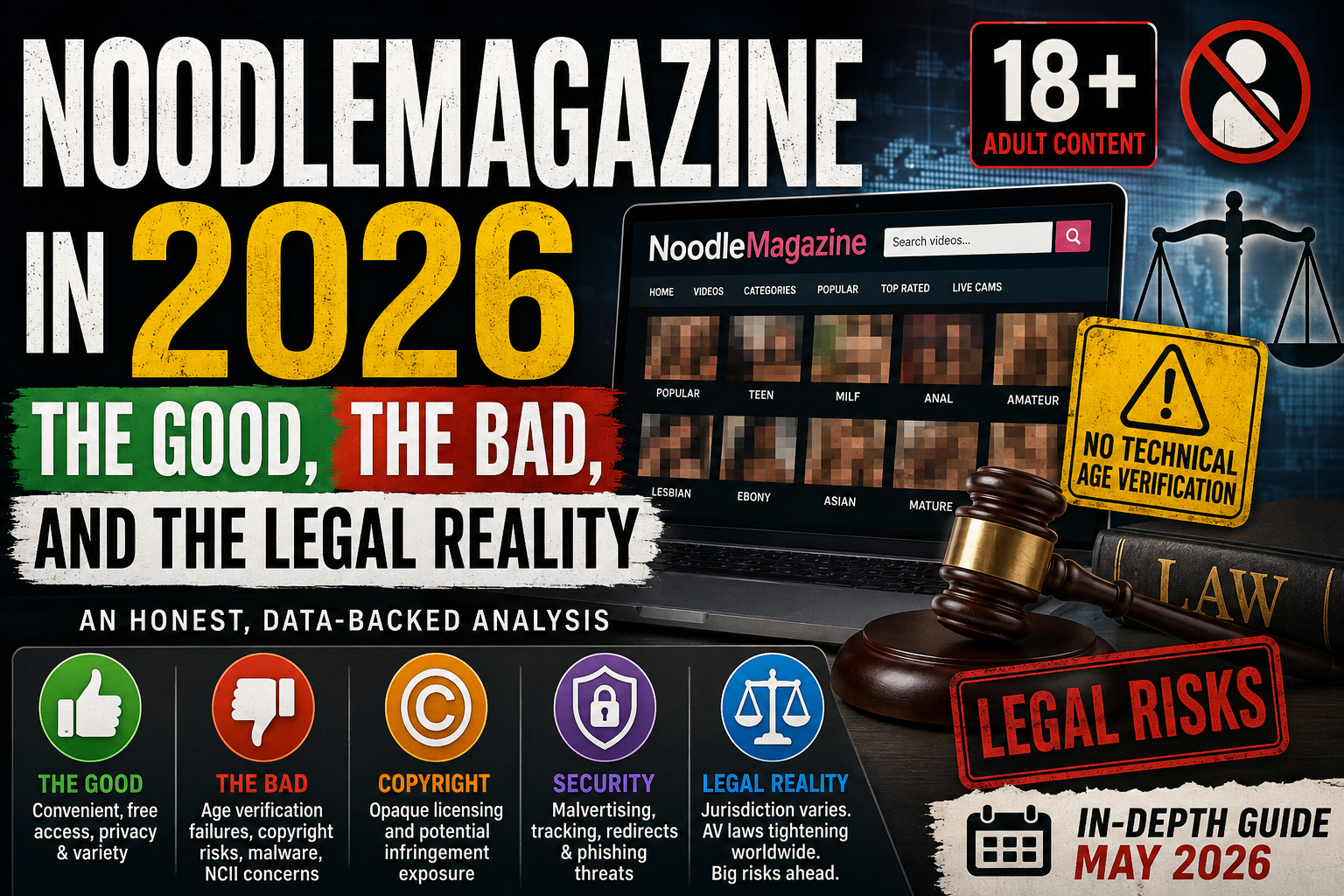
Let’s start with the plain truth: Noodlemagazine.com is an adult content platform. It is a free video streaming site in the same category as other well-known tube sites — hosting explicit video content across a wide range of genres, operating on an advertising revenue model, and requiring no subscription or account to access its content.
It is not a scam. It is not a parody. It is not an elaborate art project or a clever social experiment (though it has accidentally functioned as one). It is a fully operational adult website that happens to have a name that sounds like it belongs to a wholesome food publication.
The platform’s interface follows the standard format of free adult tube sites: a homepage populated with thumbnail previews, category tags for filtering content, a search bar, and an autoplay function. In terms of technical function, there is nothing particularly unusual about it. What makes it unusual — extraordinarily so — is entirely the name.
The Name: Genius, Accident, or Both?
The central question that everyone who encounters Noodlemagazine eventually asks is: why is it called that?
No verified public statement from the site’s owners or creators explains the naming decision. What we can say is that the name achieves something remarkable: it is completely and categorically wrong for what the site contains, and yet it is memorable in a way that a more straightforward name would never be.
“Noodlemagazine” sounds like something you would find on a Pinterest board titled Comfort Food Diaries. It evokes warmth, carbohydrates, and soft-focus photography of steaming bowls. It suggests editorial thoughtfulness — a magazine, after all, implies curation, design, and intention. The word “noodle” is among the least threatening words in the English language. It is a children’s word. It is the name of a food beloved across cultures. It is the kind of word that makes people smile involuntarily.
Put that word next to “magazine” and you have a brand that reads as entirely innocent, faintly artsy, and probably Brooklynite in its aesthetic sensibilities. Nothing about it signals adult content. Nothing about it raises any alarm whatsoever.
That is, of course, precisely the problem — and the point.
Whether the name was chosen deliberately to create this dissonance, or whether it was simply a random choice that happened to produce a spectacular mismatch, the practical effect has been the same: the name alone generates curiosity, confusion, and clicks in a way that a more explicit name never could. In a crowded market where countless sites compete for attention, Noodlemagazine’s name is its single most powerful feature. You remember it. You tell people about it. You wonder, briefly, if you have misheard.
The Anatomy of a Viral Misunderstanding
To understand why Noodlemagazine became a cultural touchstone, it helps to understand how internet virality actually works — and why confusion, specifically, is one of its most reliable engines.
The internet has always had a special affection for the bait-and-switch: the moment when expectation and reality collide in the most jarring way possible. This is the entire mechanism behind Rickrolling, behind countless viral moments where the joke is simply the gap between what something appears to be and what it actually is. Noodlemagazine is a near-perfect specimen of this dynamic.
The typical user journey goes something like this: someone hears the name — from a friend, a social media post, a comment thread — and their brain immediately files it under “food content.” They click out of mild curiosity, expecting something pleasant. The reality arrives instantly and completely. The shock is not dangerous, not traumatic, but it is total and immediate, and it produces exactly the kind of shareable reaction that the internet runs on.
What followed was a self-sustaining viral loop, driven by four overlapping communities:
The accidental clickers discovered the site by following a link or recommendation and genuinely did not know what they were getting into. Their reactions — posted as TikToks, Reddit comments, tweets, or YouTube videos — became the primary content engine for the site’s viral spread. The shock on someone’s face when they realize what “Noodlemagazine” actually is has proven reliably entertaining regardless of how many times you have seen it.
The meme community adopted the name as a reference, a punchline, and a shorthand. Once enough people knew what Noodlemagazine was, the name alone became a joke — one that could be deployed in comment sections, Discord servers, and group chats to provoke a reaction from anyone who had not yet encountered it.
The content creators — YouTubers, TikTokers, and streamers — built entire videos around the reaction format. The setup is simple: present the name, click the site, film the reaction. The format required almost no creative effort and reliably performed well, which meant it was reproduced dozens of times across multiple platforms. Each new reaction video introduced the site to a fresh audience, restarting the cycle.
The social media strategists — people who understood that referencing the site obliquely, using spelling variations or vague allusions, could generate engagement without triggering platform moderation — made Noodlemagazine a fixture of comment culture. A reply that simply reads “noodlemag” on the right post can generate hundreds of responses from people who get the reference and people who do not, both reacting in ways that boost the post algorithmically.
The result of all four groups operating simultaneously was a viral phenomenon that has proven unusually durable. Most memes have a half-life of weeks. Noodlemagazine has been circulating for years and continues to generate new reactions from people who encounter it for the first time.
The Search Variations: More Than Just Typos
One of the more interesting byproducts of Noodlemagazine’s viral spread is the ecosystem of spelling variations that has grown up around it. People searching for the site — or referencing it on social media — routinely use alternative spellings:
- noodlemag — the most common shorthand
- noodle mag — the spaced version, which reads more naturally as a publication name
- noddle magazine — a common typo that has taken on a life of its own
- noodlemgazine — a keyboard-error variant that nonetheless returns relevant results
- noodle magazinr — another frequent typo, possibly the result of touchscreen keyboard drift
These variations exist for several distinct reasons, and it is worth separating them.
Some are genuinely accidental — people mistype the name because they are searching quickly or on a small screen. Others are deliberate evasions. Social media platforms use keyword filtering systems to flag content that references adult material. Creators and commenters who want to discuss Noodlemagazine without triggering these filters use intentional misspellings as a kind of code. Noddle magazine or noodlemag can appear in a comment without being caught by an automated system looking specifically for the correctly spelled site name. This is a widely understood workaround in internet culture.
A third category of variation is purely performative — part of the joke. Using an obviously wrong spelling signals in-group membership: the person writing it knows what they mean, their audience knows what they mean, and the misspelling itself adds a layer of ironic distance that is part of the humor.
Taken together, these variations have made Noodlemagazine one of those cultural references that exists almost independently of the actual site. You can participate in the joke without ever visiting the platform. The name, and its many mutations, is the cultural artifact.
How It Spread Across Different Platforms
The way Noodlemagazine propagated across the internet followed different patterns on different platforms, each shaped by the platform’s culture and content moderation approach.
TikTok was probably the most significant driver of mass awareness. Short-form video is the ideal format for reaction content, and Noodlemagazine reaction videos fit the format perfectly: short setup, immediate payoff, shareable punchline. Creators filmed themselves clicking the site for the first time, often with a friend or in front of an audience, and the videos routinely accumulated millions of views.
Reddit provided depth and longevity. While TikTok drove spikes of awareness, Reddit communities — particularly r/InternetIsBeautiful, r/NoStupidQuestions, and various meme subreddits — generated sustained discussion. Threads with titles like “Is Noodlemagazine actually about food?” accumulated thousands of upvotes and comments, remaining discoverable through search for months afterward.
YouTube extended the content lifecycle through longer reaction and commentary videos. Unlike the short TikTok format, YouTube creators could build five-to-ten-minute videos around the premise — adding commentary, testing different reactions, or exploring the cultural phenomenon itself. These videos served as reference material for people who wanted to understand the joke without clicking the site themselves.
Twitter and Instagram spread the reference primarily through text and screenshot formats. A well-timed tweet about Noodlemagazine could accumulate tens of thousands of likes without requiring any visual content at all.
What is striking about this cross-platform spread is how little the actual content of the site mattered to it. Noodlemagazine became famous not because of what it contains, but because of the reaction it provokes. The site is, in a sense, a prop.
Is Noodlemagazine Safe to Visit?
For anyone who is genuinely curious — or who needs to answer this question for someone else — a clear-eyed safety assessment is worth providing.
The site itself is not a scam or a phishing operation. It is a functioning adult platform that delivers what it advertises (however misleadingly the advertising works). You will not be asked for credit card information, and you will not be enrolled in a subscription without your knowledge.
Advertising is the primary risk vector. Like the majority of free adult tube sites, Noodlemagazine is monetized through display advertising, and the quality control on that advertising is limited. Third-party ad networks frequently serve ads that are themselves malicious — fake download buttons, browser hijacking scripts, deceptive pop-ups that impersonate system warnings, and links to phishing pages. The site itself may be clean while the ads running on it are not.
Practical protective measures:
- Use an ad blocker. uBlock Origin is free, effective, and widely recommended.
- Use private browsing mode. This limits cookie tracking and prevents the session from being stored in your browser history.
- Use a VPN if privacy matters to you. Free tube sites routinely log IP addresses and browsing behavior. Note that free VPN services often present their own privacy risks; paid options from established providers are significantly more reliable.
- Do not download anything the site prompts you to install. Any pop-up suggesting you need a codec, a player update, or a browser extension to view content is almost certainly malicious.
- Do not click banner advertisements. Even if an ad looks legitimate, clicking it on a site like this carries meaningful risk.
For parents specifically: Standard parental control software will block Noodlemagazine by category (adult content). DNS filtering services like Cloudflare’s 1.1.1.1 for Families or OpenDNS FamilyShield will prevent access at the network level without requiring device-by-device configuration.
Noodlemagazine and Internet Meme Culture
Beyond its function as a website, Noodlemagazine has become a genuine cultural artifact — one of those references that circulates independently of its source and takes on meaning through repetition and context.
It sits in a category of internet phenomena that are famous primarily for the reaction they generate rather than the thing itself. Rickrolling is the clearest antecedent: a 1980s pop song that became a vehicle for pranking people online, famous not for its musical qualities but for the experience of being unexpectedly subjected to it.
Noodlemagazine occupies this same cultural slot for a new generation of internet users. The meme formats it has generated are stable and widely reproduced:
The innocent confession: “I visited Noodlemagazine because I thought it was about food and now I have to rethink several life choices.” This format works because it is relatable — the name really does sound like a food site — and because the understatement is inherently funny.
The ironic endorsement: “I only visit Noodlemagazine for the articles.” A direct adaptation of the classic “I read Playboy for the articles” joke, updated for the current era.
The warning: “Whatever you do, do NOT Google Noodlemagazine.” This format exploits reverse psychology — telling people not to look at something is one of the most reliable ways to make them look.
What gives these formats durability is that they work on two levels simultaneously. For people who already know the reference, they are a form of in-group signaling. For people who do not, they generate exactly the kind of curious click that perpetuates the cycle. The meme is self-sustaining in a way that most viral moments are not.
What Noodlemagazine Tells Us About the Internet
Strip away the jokes, and Noodlemagazine is actually a useful case study in how internet culture operates in the mid-2020s.
Names carry less information than we think. We are conditioned to assume that a name tells us something truthful about what it names. Noodlemagazine demonstrates that this assumption fails regularly online. In a digital environment where anyone can name anything anything, brand names are decorative rather than descriptive — signals of intent at best, active misdirection at worst.
Confusion is a growth strategy. Most brands work hard to communicate clearly what they are and what they offer. Noodlemagazine — accidentally or not — grew primarily through the failure of that communication. Millions of people know the name not because they sought out adult content but because the name confused them, amused them, or gave them something to share. The platform benefited from every single one of those interactions.
Reaction is content. The site generates almost no original discussion about its actual content. What it generates is discussion about the experience of encountering it. In this sense, the users — not the platform — created the content that made it famous. This is a pattern that repeats across internet culture: the audience’s reaction becomes more significant than the original thing.
Filtering systems are always one step behind. The proliferation of spelling variations for Noodlemagazine is a small but clear example of how content moderation works in practice. Platforms block specific terms; communities route around them. The cat-and-mouse dynamic between automated filters and human ingenuity is one of the defining features of online communication in this era.
Frequently Asked Questions
What is Noodlemagazine?
It is an adult video streaming platform. Despite its name, it has no connection to food, cooking, or magazine publishing.
Why is it called Noodlemagazine?
No public explanation from the site’s operators exists. The name appears to be chosen — deliberately or accidentally — for its misleading quality. It sounds completely harmless, which creates maximum contrast with the site’s actual content.
Why do people spell it so many different ways?
Variations like “noodlemag,” “noddle magazine,” “noodle mag,” and “noodlemagazine” exist for three reasons: accidental typos, deliberate evasion of social media content filters, and ironic humor. All refer to the same site.
Is it safe to visit?
It is not a scam, but it carries standard risks: aggressive third-party advertising that may include malicious redirects, routine data collection and IP logging, and pop-ups designed to trick users. Use an ad blocker, browse privately, and do not click banner advertisements.
How did it go viral?
Through a combination of accidental discovery, reaction content on TikTok and YouTube, Reddit discussion threads, and the inherent shareability of something with such an absurd name. The joke essentially spread itself.
Can parents block it?
Yes. Parental control software will block it by content category. Network-level DNS filtering services — such as Cloudflare’s 1.1.1.1 for Families or OpenDNS FamilyShield — block access across all devices on a network without requiring individual device configuration.
Will I ever hear the word “noodle” the same way again?
Almost certainly not. That appears to be the site’s most lasting cultural contribution.
This article is intended for informational purposes. It examines Noodlemagazine as a cultural and internet phenomenon, not as an endorsement of the platform or its content.
READ MORE ABOUT EasyJet Flight U2238: Emergency Landing at Newcastle Guide –