CDiPhone Review 2026: The AI iPhone That Brings Photos to Life
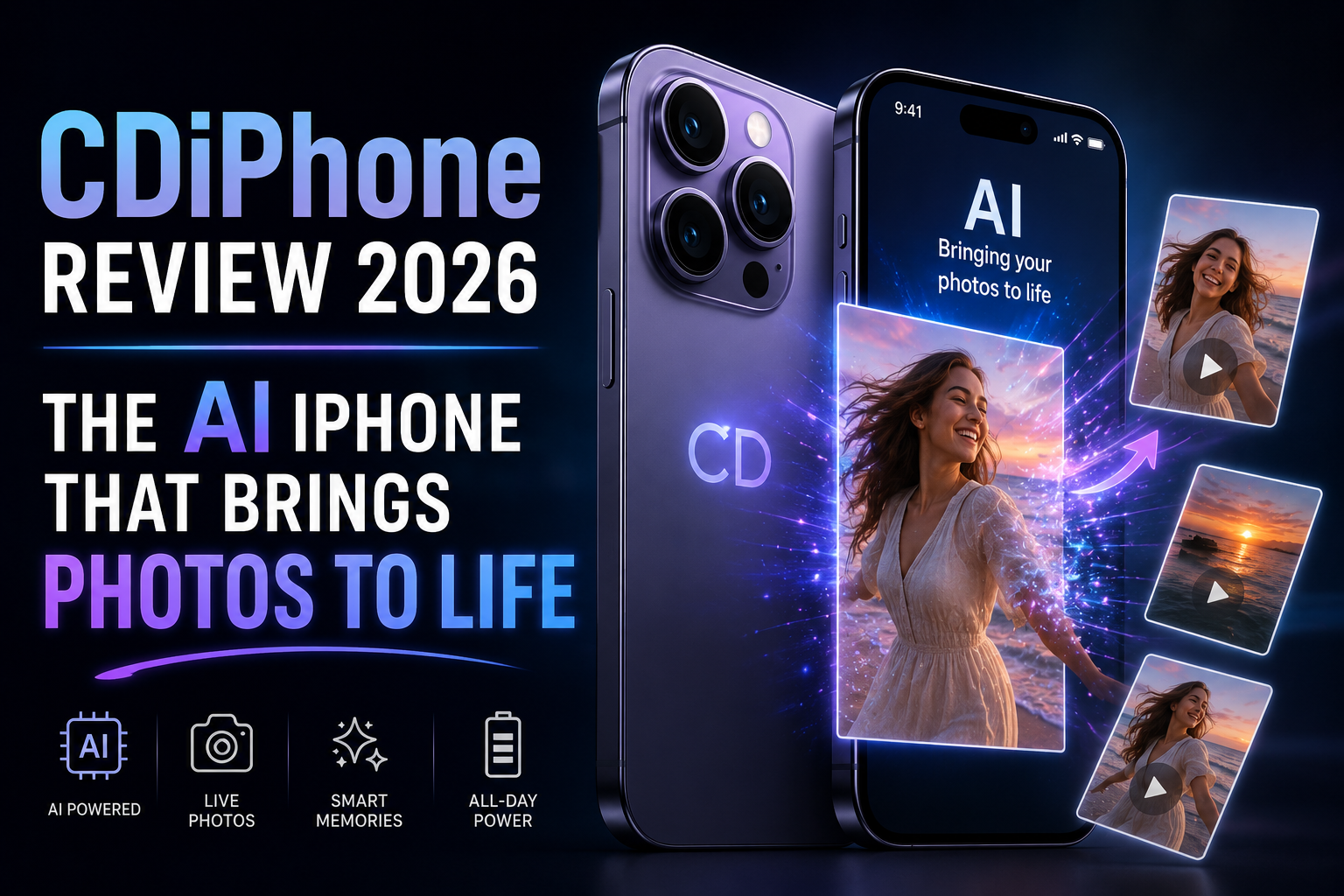
Imagine snapping a quick photo of your child laughing at a birthday party — and watching that still image transform into a warm, natural short video in under 30 seconds, right on your phone. No laptop. No expensive editing software. No technical skills required. Just your iPhone, one tap, and a little AI magic.
That is exactly what CDiPhone promises to deliver, and in 2026, it is living up to the hype. As AI-powered smartphones become the new standard, CDiPhone stands out as one of the most talked-about concepts in mobile technology — a bold reimagining of what your iPhone can do when powerful hardware meets next-generation artificial intelligence.
Whether you’ve been searching for “CDiPhone review,” “best AI iPhone 2026,” or “how to turn photos into videos on iPhone,” this in-depth guide covers everything you need to know. Let’s dive in.
What Is CDiPhone? A Complete Explanation for 2026
The term CDiPhone refers to a new generation of AI-enhanced iPhone experience that combines your phone’s camera, on-device processing power, and advanced generative AI into one seamless creative toolkit. Think of it as your all-in-one studio for photos, short videos, and animated content — built directly into the device already in your pocket.
Unlike basic iPhone models that simply record whatever is in front of the lens, CDiPhone uses intelligent software to analyze your images and bring them to life. You can take a still photo, describe an action in plain words — “make the leaves blow gently in the wind” — and watch as the AI generates smooth, natural motion within seconds.
CDiPhone is not a separate gadget you purchase. It is a philosophy and a feature set that defines how the latest iPhones are being used for creative content in 2026. It is especially popular among:
- Parents who want to preserve family memories as moving pictures
- Small business owners looking for quick, professional marketing content
- Students and hobbyists experimenting with creative video projects
- Social media creators who need eye-catching short clips for platforms like Instagram and TikTok
- Teachers and educators who want engaging visual content for lessons
The core idea is simple: your iPhone should not just capture the world. It should help you tell stories about it.
Why CDiPhone Is Trending in 2026: The AI Revolution Behind It
People searching for “AI iPhone 2026,” “best smartphone for video creation,” or “iPhone generative AI features” are increasingly landing on CDiPhone content — and for good reason. Several major shifts in mobile AI technology have made this concept possible in ways that simply were not achievable even two years ago.
1. On-Device AI Processing Has Reached a New Peak
The latest iPhone chips handle enormous AI workloads without needing to send your data to external cloud servers. This means faster results, stronger privacy, and the ability to create videos even without a Wi-Fi connection. What once took minutes on a desktop computer now finishes in seconds on a device you carry in your pocket.
2. Generative AI Can Now Produce Realistic Motion From Still Images
The most exciting development behind CDiPhone is the improvement in image-to-video AI generation. In 2024 and 2025, early versions of this technology produced jerky, unnatural animations. By 2026, the same technology creates fluid, convincing motion that respects the original photo’s lighting, colors, and composition. Faces stay consistent. Objects move believably. The results actually look good.
3. AI Understands Plain Language Instructions Better Than Ever
You no longer need to learn complex prompt engineering to get great results. If you tell CDiPhone’s AI “make my dog run happily from the left side to the right side of the frame,” it understands and delivers. This natural language improvement is one of the biggest reasons everyday users are embracing AI photo tools in 2026.
CDiPhone Key Features: Everything You Need to Know
Advanced AI-Powered Camera System
The CDiPhone camera goes beyond simply taking sharp, well-exposed photos. It uses real-time AI analysis to understand the content of your frame — faces, objects, backgrounds, lighting — and immediately suggests creative possibilities. When you point the camera at your morning coffee, the AI sees the steam, the cup, the texture of the foam, and recognizes the opportunity for a beautiful animated clip.
This smart camera behavior is part of why searches for “best iPhone camera 2026” and “AI camera iPhone” frequently connect to CDiPhone discussions.
Real-Time Generative Editing
One of the most impressive CDiPhone features is the ability to make edits and see results almost immediately. You adjust a slider for motion intensity, change a word in your instruction, and the preview updates in near real-time. This interactive feedback loop makes learning the tool fast and satisfying, even for complete beginners.
Seamless Motion and Video Enhancement
CDiPhone excels at adding natural, physics-aware movement to still images. A flag waves realistically. Candle flames flicker with the right randomness. Water ripples in a way that responds to imagined wind direction. The AI studies the original photo’s visual cues and uses them to guide how motion should behave.
This is the feature that makes CDiPhone particularly useful for creating social media video content from photos — one of the most-searched topics among content creators this year.
All-in-One Creative Suite
Everything lives in one place. You move from capturing a photo to animating it, adding background sound suggestions, applying stylistic filters, and sharing to social platforms — without ever leaving the main app. This all-in-one workflow saves significant time compared to bouncing between separate apps for editing, conversion, and sharing.
Superior Face and Object Consistency
Earlier AI video tools had a frustrating problem: faces and objects would change subtly but noticeably as the animation played. A person’s nose might shift. Hair would behave strangely. CDiPhone’s 2026 AI engine solved this by dramatically improving object tracking across frames. Your grandmother’s smile in a photo stays her smile throughout the entire animated clip. This consistency is what makes the results feel real and shareable.
Lightning-Fast Generation Speeds
Speed is a quality-of-life improvement that truly changes how you use a tool. CDiPhone generates most short clips in under 30 seconds. Longer or more complex scenes might take up to two minutes, but a clear progress indicator keeps you informed. This speed allows for rapid experimentation — try one idea, see the result, tweak it, try again — without losing patience.
Precise Start and End Frame Control
A standout technical feature for more advanced users is the ability to set both the opening frame and the closing frame of a generated video. You pick Photo A (how the scene begins) and Photo B (how it should end), and the AI intelligently fills in the motion between them. This opens up creative storytelling possibilities that were previously only available in professional video software.
How CDiPhone Uses 2026 AI Advancements: The Tech Behind the Magic
Understanding what makes CDiPhone work helps you use it better and appreciate why results have improved so dramatically.
Neural Engine Integration
Modern iPhones contain dedicated neural processing units — specialized hardware designed specifically for AI tasks. CDiPhone leverages these chips to run complex image analysis and video generation models entirely on-device. The result is a system that responds quickly, protects your privacy (your photos never need to leave your phone for basic tasks), and works consistently regardless of your internet connection.
Diffusion Model Technology
The AI that generates motion from still photos uses a type of technology called a diffusion model. In simple terms, the AI learns from millions of videos what natural movement looks like, then applies that knowledge to your photo. It works by making thousands of tiny adjustments until the generated motion matches what the AI “expects” to see in a real scene. The 2026 versions of these models are significantly more refined than their predecessors, producing smoother motion and better color consistency.
Prompt Understanding Improvements
The language model that interprets your instructions has become substantially smarter. It handles nuance better — understanding the difference between “gently blowing leaves” and “leaves scattered by a storm” — and applies that nuance accurately to the generated motion. It also avoids common AI pitfalls like adding unwanted elements or misinterpreting color and style directions.
Adaptive Learning From Your Preferences
Over time, CDiPhone pays attention to the kinds of results you save and share versus the ones you discard. This pattern recognition allows the system to subtly tailor its suggestions toward your personal style, making it feel more intuitive the longer you use it.
CDiPhone Practical Use Cases: Real People, Real Results
Family Memories That Actually Move
A parent in Ohio took a still photo of her son blowing out birthday candles and used CDiPhone to add gentle, realistic motion. The candles flickered. The boy leaned forward with cheeks puffed. Friends in the background shifted naturally. What was a single static frame became a 10-second video the family still watches. This type of use case — turning old photos into videos — is among the most searched topics connected to AI iPhone tools.
Small Business Marketing on a Budget
A coffee shop owner uses CDiPhone weekly to create promotional content. She photographs a fresh pour, a new seasonal drink, or a cozy corner of her shop, then generates a 5-to-10-second clip with gentle steam rising or warm light shifting. These clips perform significantly better on social media than static product photos and require no videographer, no editing software, and no more than five minutes of her time.
Short-Form Social Media Content Creation
For creators building audiences on Instagram Reels, TikTok, and YouTube Shorts, CDiPhone is a practical tool for filling content calendars. One photograph can become multiple different animated clips by varying the motion style, speed, or visual filter. A creator who once needed hours to produce engaging video content can now generate a week’s worth of short clips in a single afternoon.
Educational and Classroom Applications
Teachers have found CDiPhone valuable for making learning materials more engaging. A biology teacher animated a diagram of a plant’s growth cycle. A history teacher brought a photograph of a historical location to life with atmospheric motion — clouds moving, trees swaying — to set the scene before a lesson. Students respond to moving visuals with greater attention and retention.
Hobby Art and Creative Experimentation
Painters, illustrators, and photographers use CDiPhone to explore new dimensions of their existing work. A watercolor painting photographed and animated into a swirling, flowing clip becomes shareable digital art. A black-and-white photograph from a grandparent’s era gains new life with subtle, respectful animation.
CDiPhone vs Regular iPhones and Competing Smartphones
How CDiPhone Differs From the Standard iPhone Experience
Standard iPhone models — including recent releases — are exceptional at capturing photos and recording video. What they do not do natively is generate new content from existing images. CDiPhone fills that creative gap. It takes what your iPhone already captures and gives you tools to transform it, something that requires expensive desktop software or separate AI apps on traditional smartphones.
CDiPhone vs. AI Features on Android Competitors
Several Android manufacturers have introduced AI-enhanced camera features in 2025 and 2026. Google’s Pixel line offers impressive AI editing tools. Samsung’s Galaxy series includes creative AI modes. However, CDiPhone’s advantage lies in how tightly integrated the AI is with Apple’s hardware. The neural engine in Apple’s chips is purpose-built for these workloads, and the software optimization that comes with Apple’s controlled ecosystem means smoother performance, better power efficiency, and more consistent results.
CDiPhone vs. Standalone AI Video Apps
Separate AI video generation apps exist for both iOS and Android, but they introduce friction. You export a photo to an app, wait for it to upload to a cloud server, wait for processing, download the result, then import it into your camera roll or editing app. CDiPhone collapses this entire workflow into a few taps with no uploads required for basic generation. Speed and privacy both win.
Honest Limitations Worth Knowing
No technology is perfect, and CDiPhone is no exception. Here are realistic limitations to keep in mind:
- Complex scenes with many moving parts may require multiple attempts before the AI generates a satisfying result
- Battery consumption increases significantly during video generation, especially for longer or more detailed clips — keeping a charger available for extended creative sessions is smart
- Source photo quality matters enormously — blurry, poorly lit, or heavily compressed images produce noticeably worse animated results than sharp, well-exposed starting photos
- Very long videos (over 15–20 seconds) are still inconsistent in quality and work best as multiple shorter clips stitched together
How to Get Started With CDiPhone: A Step-by-Step Beginner Guide
For anyone searching “how to use CDiPhone” or “CDiPhone tutorial for beginners,” here is a practical starting framework.
Step 1: Prepare Your Device
Make sure your iPhone’s software is updated to the latest available version. Software updates in 2026 have consistently brought AI performance improvements that matter for generation quality and speed. Ensure you have adequate storage available — generated video clips take approximately the same space as regular iPhone video at similar resolution.
Step 2: Start With a Strong Source Photo
The single most impactful thing you can do for better results is start with a high-quality, well-lit photograph. Natural light or consistent indoor lighting works best. Avoid heavily filtered images or photos with significant motion blur. The AI’s ability to generate convincing motion scales directly with the clarity of the source image.
Step 3: Use the “Bring to Life” Feature
Open your photo library, select any image, and look for the Bring to Life option in the editing tools. This is your entry point to CDiPhone’s core generative capabilities. On your first attempt, use the default motion settings rather than customizing everything at once. See what the AI produces naturally.
Step 4: Write Clear, Specific Motion Instructions
When typing a prompt, specificity beats complexity. Instead of writing “make it look cool,” try “add gentle wind blowing from right to left, making the trees sway slowly.” Instead of “animate the face,” try “have the person blink once and smile slightly.” The AI responds much better to concrete physical descriptions than to abstract style words.
A useful prompt formula to save and reuse:
“Starting from [brief description of photo], add [specific movement], in [lighting or weather condition], keeping [important detail like face or object] consistent throughout.”
Step 5: Iterate With Single Changes
When results are not quite right, change only one thing at a time. Adjust the motion speed, change one word in your instruction, or try a different lighting style. Making multiple simultaneous changes makes it impossible to know what actually improved the result.
Step 6: Save Only What You Love
Storage management matters. CDiPhone makes it easy to generate many versions quickly, which means your camera roll can fill up fast. Build a habit of reviewing and deleting rejected generations immediately, keeping only the clips you actually want to share or keep.
Tips and Common Beginner Mistakes to Avoid
Mistake 1: Using Dark or Blurry Source Photos
This is the most common reason beginners get disappointing results. The AI cannot invent detail that is not there. A sharp, properly exposed photo in good light will always outperform a dark or blurry one, regardless of how good the motion prompt is.
Mistake 2: Overloading the AI With Too Many Instructions
Writing a five-sentence prompt full of conditions and stylistic requirements often produces worse results than a single clear sentence. Start simple. Build complexity gradually as you learn what works.
Mistake 3: Expecting Long Videos on the First Try
CDiPhone shines for clips between 5 and 15 seconds. New users sometimes expect cinematic 60-second results and are disappointed. Master the short form first — these brief clips are also exactly what performs best on social media.
Mistake 4: Ignoring the Start/End Frame Feature
More experienced users who ignore the start and end frame control are missing one of CDiPhone’s most powerful creative tools. Even simple two-photo sequences — a closed door followed by an open door, a flower bud followed by a bloom — can produce surprisingly compelling results.
Privacy and Security: What Happens to Your Photos?
This is a genuinely important question, and one worth searching for if you plan to use CDiPhone with photos of your family, especially children.
The good news: CDiPhone’s core generation engine runs on-device. Your photos are processed by the neural chip inside your iPhone, not sent to external servers. For basic animation and motion generation, your images stay on your phone.
For more advanced features that require additional computing power — complex style transformations, high-resolution outputs, or certain cloud-enhanced effects — data may be processed through secure private cloud infrastructure with strong privacy protections. Always review the specific privacy settings in your iPhone’s AI features section to confirm what stays local and what requires a network connection.
CDiPhone for Different Types of Users: Who Benefits Most?
| User Type | Primary Use | Key Benefit |
|---|---|---|
| Parents and Families | Animating memories and milestones | Emotional, lasting keepsakes from existing photos |
| Small Business Owners | Marketing content and product videos | Professional results without professional costs |
| Social Media Creators | Daily content for Reels, TikTok, Shorts | Fast production with high visual engagement |
| Teachers and Educators | Lesson materials and presentations | Attention-holding animated visuals from static diagrams |
| Hobby Artists and Photographers | Experimenting with existing work | New creative dimensions for existing portfolios |
| Beginners and Casual Users | Just having fun with photos | Accessible tools with no learning curve |
What’s Coming Next for CDiPhone: The 2027 Horizon
The development roadmap for AI-powered iPhone creativity is ambitious. Based on patterns in 2026 updates and the direction the technology is heading, here is what to reasonably expect in the coming year:
Better Audio Matching: Future updates will likely pair generated video motion with automatically suggested or composed background audio that matches the mood, speed, and content of the animation. A gentle seaside scene gets soft wave sounds. An energetic street scene gets appropriate urban ambience.
Multi-Photo Story Mode: Instead of animating a single image, a future mode will likely allow you to select three to five photos and let the AI generate a smooth, flowing short video narrative that transitions naturally between them — like an automatic highlight reel from your camera roll.
Emotion Awareness in Faces: AI is getting better at reading the emotional tone of a face in a photo and using that to guide how the animated face should move — matching the energy of a laughing photo with appropriately joyful motion.
Even Faster Generation: Speed improvements continue with each chip generation. What takes 30 seconds today may take 5 seconds on the next iPhone hardware.
Frequently Asked Questions About CDiPhone
What is CDiPhone and is it a real product?
CDiPhone describes an AI-enhanced iPhone experience focused on generative photo-to-video creation. It is a concept that describes how the latest iPhones are being used for AI-driven creative work in 2026, not a separately sold device.
How long does a CDiPhone video generation take?
Most short clips (5–10 seconds) generate in under 30 seconds on current hardware. More complex or longer generations may take one to two minutes.
Can I use CDiPhone with old photos?
Yes. The AI works with any photo in your library. Older photos produce better results when they are sharp and well-lit, but the tool can handle vintage photographs with reasonable success.
Does CDiPhone need an internet connection?
Basic generation runs entirely on-device with no connection required. Advanced features and certain styles benefit from a Wi-Fi connection for additional processing power.
Is CDiPhone safe for children’s photos?
The tools include built-in content safety filters that avoid producing disturbing, inappropriate, or unnatural results. For photos of children, results are consistently appropriate when instructions are kept friendly and clear.
How much storage do CDiPhone videos use?
Generated short clips use approximately the same storage as regular iPhone video recorded at similar resolution. A 10-second clip typically uses 15–40 MB depending on resolution and complexity.
Can beginners really use CDiPhone without technical knowledge?
Absolutely. The interface is designed around large, clear buttons and simple language. If you can tap a screen and type a short sentence, you can produce your first animated clip within minutes.
Will CDiPhone improve over time?
Yes. Software updates pushed to compatible iPhones regularly bring generation quality improvements, new creative modes, and speed enhancements — all at no additional cost.
Final Verdict: Is CDiPhone Worth Your Attention in 2026?
The short answer is yes — emphatically.
CDiPhone represents exactly the kind of technology that feels genuinely useful rather than gimmicky. It does not ask you to learn new skills or invest in new gear. It takes something you already do — take photos on your iPhone — and adds a meaningful new creative dimension to it.
The results are impressive enough to share. The learning curve is short enough not to frustrate. The applications are broad enough to be useful for families, businesses, and creators alike.
If you have been searching for the “best AI iPhone features 2026,” “how to animate photos on iPhone,” or “iPhone video creation tools,” CDiPhone sits at the center of all those conversations for good reason. It genuinely delivers on a simple promise: making your memories more alive.
The next time you take a photo of something that matters to you — snap it, open it, and tap Bring to Life. See what happens.
You might be pleasantly surprised by what your iPhone already knows how to do.
Disclaimer: This article is written for informational and educational purposes. AI photo and video tools evolve rapidly. Always review the latest features, privacy policies, and usage terms on your specific device and software version. Results vary based on source photo quality, software version, and device hardware.