
EasyJet Flight U2238: Emergency Landing at Newcastle Guide
Introduction
The aviation industry operates thousands of flights every single day, and the vast majority of them arrive at their destinations without incident. Yet when something unexpected happens in the air, the public takes notice. The EasyJet Flight U2238 emergency landing at Newcastle was one such event — an incident that rapidly spread across news platforms and social media, prompting passengers, travelers, and aviation enthusiasts alike to ask the same urgent questions: What happened? Were people safe? And what does this tell us about the state of modern air travel?
This comprehensive guide examines every dimension of the incident — from the moment the situation developed onboard, to the split-second decisions made by the flight crew, the response of Newcastle Airport’s emergency teams, the media coverage that followed, and the broader lessons this event offers to the traveling public. Rather than viewing this incident through a lens of fear, this article explains how the EasyJet Flight U2238 emergency landing at Newcastle actually stands as a powerful demonstration of just how robust and effective modern aviation safety systems have become.
Understanding the Incident: What We Know About EasyJet Flight U2238
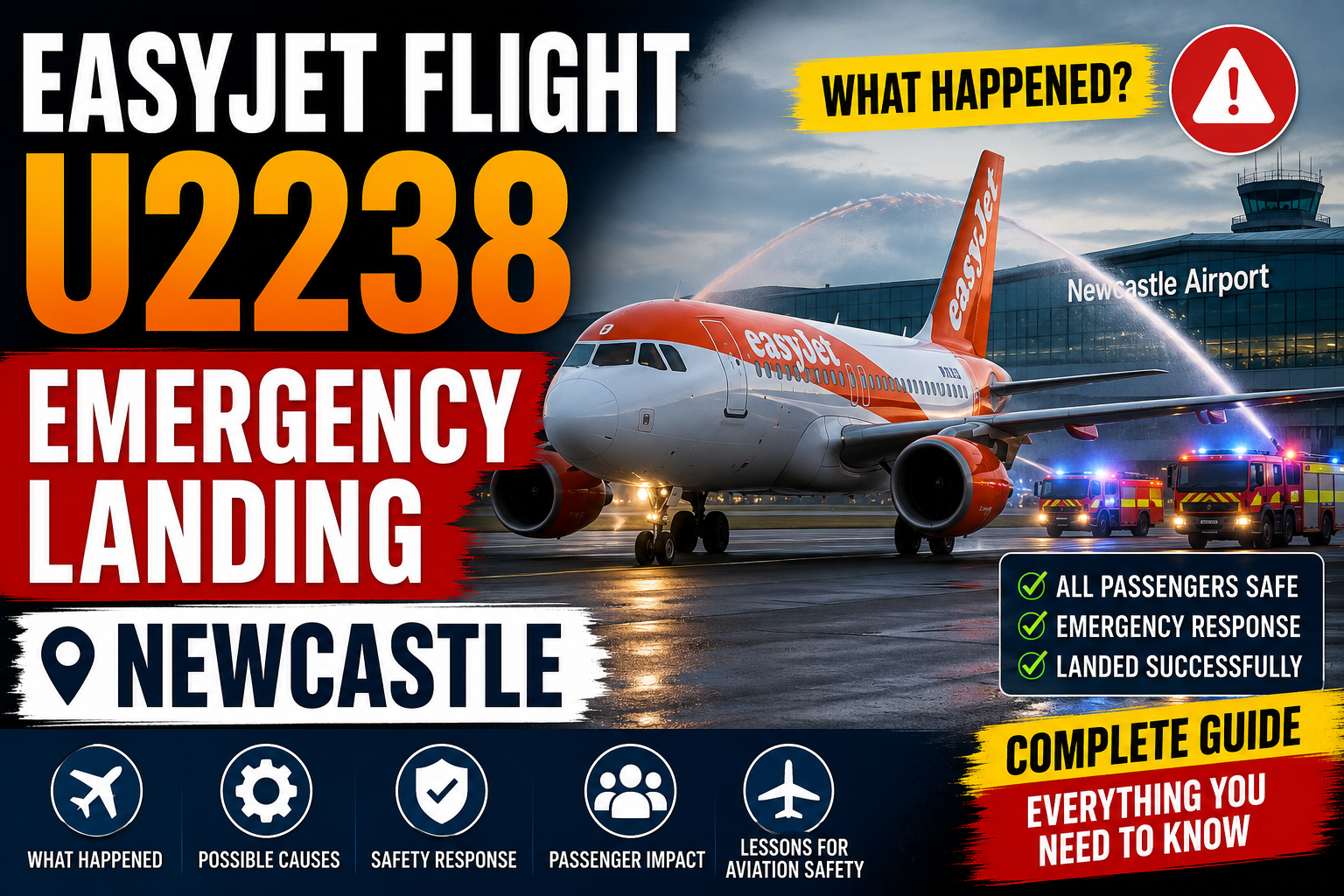
EasyJet Flight U2238 became a trending topic after reports emerged that the aircraft had diverted and landed safely at Newcastle Airport following a possible onboard issue. While early information circulated quickly across social media, the central facts remained consistent throughout: the aircraft landed safely, emergency response teams were on standby and ready, and all passengers and crew members were reported safe.
EasyJet is one of Europe’s largest and most established low-cost airlines, operating thousands of flights every week across the continent. Like all commercial carriers operating in European and international airspace, EasyJet follows strict safety regulations governed by the Civil Aviation Authority (CAA), the European Union Aviation Safety Agency (EASA), and the International Civil Aviation Organisation (ICAO). These regulations cover everything from aircraft maintenance schedules and pilot training requirements to cabin crew emergency procedures and airport readiness protocols.
Quick Facts at a Glance
| Detail | Information |
|---|---|
| Flight Number | U2238 |
| Airline | EasyJet |
| Incident Type | Emergency Landing |
| Landing Location | Newcastle Airport |
| Passenger Safety | All passengers safe |
| Emergency Response | Teams on standby |
| Aircraft Status | Landed successfully |
The successful and orderly outcome of the incident was not a matter of luck. It was the direct result of years of preparation, training, and engineering that the aviation industry has invested in to ensure that even unexpected situations are managed safely and professionally.
Possible Causes: What Triggers an Emergency Landing?
One of the first questions the public asked following the EasyJet Flight U2238 emergency landing at Newcastle was simple and understandable: what caused it? Aviation experts discussed several possible explanations, and understanding these helps demystify why emergency landings happen and why they are often far less catastrophic than the word “emergency” implies.
Technical Cockpit Warnings
Modern commercial aircraft are equipped with extraordinarily sophisticated monitoring systems that continuously track hundreds of parameters across every major system on the plane. These include cabin pressure, hydraulic system performance, engine output, fuel levels, navigation equipment, electrical systems, and more. When any of these systems detects even a minor irregularity, it triggers an alert in the cockpit.
Crucially, these alerts are designed to flag potential issues long before they develop into serious problems. A pressure warning, a hydraulic caution light, or an unfamiliar sensor reading does not necessarily mean the aircraft is in danger — but it does mean that pilots are obliged to take the situation seriously and respond according to their training. In many cases, the safest and most professional response is to divert to the nearest suitable airport for inspection, even if the issue ultimately turns out to be minor or caused by a faulty sensor.
Passenger Medical Emergencies
Flights sometimes divert not because of any issue with the aircraft itself, but because a passenger onboard requires urgent medical assistance. Medical emergencies at altitude are more common than many people realize. Heart attacks, severe allergic reactions, respiratory difficulties, and other acute health events can occur on any flight, and when they do, pilots coordinate immediately with air traffic control to divert to the nearest airport with appropriate medical facilities.
In these cases, the “emergency” is a medical one rather than a mechanical one, and the decision to divert is made entirely in the interest of the affected passenger’s welfare.
Unusual Smells or Smoke
Reports of unusual smells, fumes, or smoke inside the cabin are always taken with the utmost seriousness in aviation. Even when the source turns out to be entirely harmless — such as a malfunctioning galley appliance or a minor electrical issue — pilots cannot afford to take chances. Any report of smoke or fumes triggers immediate action, including possible descent and diversion to the nearest airport.
Precautionary Measures
Perhaps the most important point to understand about emergency landings is that a significant proportion of them are entirely precautionary. When pilots or cabin crew identify anything that causes uncertainty — whether that is an ambiguous warning light, a passenger reporting a concerning symptom, an unusual vibration, or a smell that cannot be immediately identified — the standard professional response is to land and investigate rather than continue the flight and hope the issue resolves itself.
This precautionary approach is not a sign that something has gone wrong. It is a sign that everything is working exactly as it should.
Inside the Cockpit: How Pilots Handle Emergency Situations
The EasyJet Flight U2238 emergency landing at Newcastle brought widespread attention to the remarkable skill and composure required of commercial airline pilots when unexpected situations arise. What many members of the public do not fully appreciate is just how thoroughly pilots prepare for these moments throughout their entire careers.
Simulator Training: Preparation for the Unexpected
Commercial airline pilots are required to undergo regular recurrent training in advanced flight simulators — sophisticated machines that can faithfully replicate virtually any malfunction, weather condition, or emergency scenario imaginable. These sessions occur multiple times per year throughout a pilot’s career and cover scenarios ranging from engine failures and hydraulic system losses to rapid decompression and emergency descents.
By the time a pilot encounters an unexpected situation in real flight, they have already practiced responding to similar scenarios dozens or even hundreds of times in the simulator. This training builds the kind of deeply ingrained, calm, methodical response that passengers benefit from during incidents like the EasyJet Flight U2238 emergency landing at Newcastle.
Emergency Checklists: No Step Left Behind
When a warning or unusual situation arises, pilots do not rely on memory alone. They work through carefully designed emergency checklists — structured, step-by-step procedures developed and refined over decades of aviation experience. These checklists ensure that no important action is overlooked, even under pressure.
The use of checklists is a cornerstone of aviation safety culture and one of the reasons the industry’s safety record is so strong. Every action taken during an emergency is deliberate, verified, and recorded.
Communication and Coordination
Simultaneously with managing the onboard situation, pilots maintain constant communication with air traffic control. Controllers on the ground can provide critical assistance — clearing airspace, coordinating with the destination airport’s emergency services, providing weather updates, and helping pilots select the most suitable diversion airport based on current conditions.
Airline operations centers are also notified immediately, allowing the airline’s own teams to begin coordinating passenger support, maintenance response, and communications.
Selecting the Right Airport
Choosing where to land during an emergency is not a simple decision. Pilots weigh multiple factors simultaneously, including runway length and surface condition, current weather at potential airports, the nature and severity of the onboard situation, proximity to the nearest suitable facility, availability of emergency services, current fuel levels, and aircraft weight considerations. Newcastle Airport’s capabilities, location, and emergency team readiness made it the appropriate choice in this instance.
The Human Element: Cabin Crew and Passenger Experience
While the pilots manage the technical aspects of an emergency landing, the cabin crew play an equally vital role in ensuring passenger safety and wellbeing throughout the experience.
Cabin Crew Training and Professionalism
EasyJet cabin crew members, like those at all major commercial airlines, undergo extensive initial training and regular recurrent training in emergency procedures. This training covers evacuation procedures, first aid, fire fighting, ditching at sea, passenger management during turbulence, and communication protocols during emergency situations.
During an incident like the EasyJet Flight U2238 emergency landing at Newcastle, cabin crew members are responsible for keeping passengers calm, informed, and seated safely. Their body language, tone of voice, and clear instructions have a measurable impact on how passengers experience the situation. A calm, confident cabin crew communicates to passengers that the situation is being managed professionally — even when the circumstances are unusual.
The Passenger Perspective
For passengers aboard Flight U2238, the experience of an unexpected emergency landing would naturally have been stressful. Hearing a public address announcement about a diversion or seeing unusual activity in the cabin triggers anxiety in even experienced travelers.
Many passengers who have been through precautionary emergency landings describe a similar emotional arc: initial alarm, followed by reassurance from cabin crew, followed by relief upon landing safely, and often genuine admiration for the professionalism shown by the flight crew throughout. Social media posts during and after the incident reflected this pattern, with many passengers expressing gratitude for the calm and efficient way the situation was handled.
It is worth noting that social media also plays a complex role in incidents like this one. Information — and misinformation — spreads rapidly online before official statements are released. Aviation experts consistently recommend waiting for confirmed reports from the airline and airport authorities before drawing conclusions about the severity of any incident.
Newcastle Airport’s Emergency Response: Preparation in Action
Newcastle Airport’s performance during the EasyJet Flight U2238 emergency landing demonstrated the level of preparedness that modern airports maintain at all times. Emergency response teams were reportedly on standby and in position before the aircraft even touched down — a reflection of the airport’s training, communication systems, and operational readiness.
The Airport Emergency Response Structure
Airport emergency planning is a complex, multi-departmental operation that brings together several specialized teams, each with clearly defined responsibilities.
| Emergency Team | Primary Responsibility |
|---|---|
| Airport Fire Service | Aircraft fire suppression and rescue |
| Medical Teams | Passenger and crew medical assistance |
| Air Traffic Control | Flight coordination and sequencing |
| Security Teams | Perimeter and access management |
| Ground Operations | Aircraft positioning and support |
| Passenger Services | Welfare and communications |
These teams do not simply exist on paper. They conduct regular full-scale emergency exercises — known as major incident exercises — that simulate realistic scenarios including aircraft fires, mass casualty events, and technical emergencies. These drills ensure that when real situations occur, every team member knows their role, their position, and their responsibilities without hesitation.
Regulatory Requirements for Airport Emergency Planning
Every commercial airport in the United Kingdom is required to maintain a detailed Airport Emergency Plan (AEP) that outlines how the airport will respond to a range of emergency scenarios. This plan is reviewed regularly, tested through exercises, and updated in response to new guidance from the CAA and other aviation authorities.
Newcastle Airport, as a regulated commercial airport, operates under these requirements and maintains the capability to respond swiftly and effectively to aviation emergencies — as demonstrated during the U2238 incident.
Media Coverage and Public Perception: Understanding the Narrative
The way the EasyJet Flight U2238 emergency landing at Newcastle was covered by media outlets illustrates a broader challenge in aviation journalism: the gap between how incidents are presented and what they actually represent in terms of risk.
Why Emergency Landings Make Headlines
The phrase “emergency landing” carries inherent drama. For most members of the public, it conjures images of stricken aircraft and terrified passengers. This perception drives clicks, views, and shares — which means media outlets have an incentive to present even routine precautionary diversions in the most dramatic terms available.
In reality, the vast majority of emergency landings result in exactly the outcome seen with Flight U2238: a safe landing, no injuries, and a thorough technical inspection of the aircraft before it returns to service.
The Importance of Context
Aviation experts consistently emphasize the importance of context when evaluating incidents like this one. Commercial aviation is, by virtually every measurable standard, the safest form of long-distance transportation in human history. The rate of fatal accidents per mile traveled in commercial aviation is extraordinarily low — far lower than road transport, and lower even than many forms of rail travel.
When an emergency landing makes headlines, it is partly because such events are genuinely rare enough to be newsworthy. If emergency landings were common and deadly, they would not generate the same level of public interest — they would simply be an accepted part of life. Their newsworthiness is itself a reflection of how safe aviation has become.
Budget Airlines and Safety: Addressing the Misconceptions
The EasyJet Flight U2238 incident also prompted discussion about the perceived safety of low-cost carriers compared to full-service airlines. This is a misconception worth addressing directly.
In regulated aviation markets such as the European Union and the United Kingdom, all commercial airlines — regardless of their business model or ticket pricing — are required to meet exactly the same safety standards. Budget airlines cannot legally operate with lower safety standards than premium carriers. They are subject to the same maintenance requirements, the same pilot training mandates, the same airworthiness directives, and the same oversight from aviation authorities.
The difference between a budget airline and a premium carrier lies in the service experience, not the safety standard.
Why Emergency Landings Are More Common Than the Public Realizes
One of the most reassuring truths about commercial aviation is that precautionary emergency landings are considerably more common than most travelers appreciate — and their relative frequency is actually evidence of how well the system works.
Airlines have a deeply ingrained safety culture that prioritizes caution above all other considerations. When any doubt exists about the condition of an aircraft or the wellbeing of a passenger, the correct response is always to land and investigate. This philosophy means that pilots will divert for issues that turn out to be entirely minor — a sensor malfunction, a brief unusual smell, a passenger feeling unwell — because the alternative, continuing a flight with any unresolved uncertainty, is simply not acceptable in aviation culture.
Every precautionary diversion that turns out to be unnecessary is still the right decision. The cost of landing early and discovering nothing wrong is inconvenience. The cost of not landing when something was wrong could be catastrophic. Aviation’s safety culture is built on this asymmetry.
Lessons for Travelers: What the U2238 Incident Teaches Us
The EasyJet Flight U2238 emergency landing at Newcastle offers several valuable lessons for anyone who travels by air.
Emergency Does Not Mean Disaster
The single most important takeaway is that an emergency landing is not synonymous with a crash or catastrophe. In aviation, the word “emergency” describes a situation that requires immediate and prioritized attention — not necessarily one that is life-threatening. Understanding this distinction can significantly reduce the anxiety that travelers feel when they hear the term.
Trust the Crew
Cabin crew members are not simply hospitality staff. They are trained safety professionals with extensive knowledge of emergency procedures, first aid, and passenger management. During unusual situations, following their instructions without hesitation is the single most important thing a passenger can do to contribute to a safe outcome.
Stay Calm on Social Media
When unexpected events happen on flights, the instinct to share information online is understandable. However, unverified social media posts can spread misinformation rapidly and cause unnecessary alarm for families and friends of passengers. Waiting for official communications from the airline before sharing information is always the more responsible approach.
Aviation Remains Remarkably Safe
For nervous flyers in particular, incidents like the EasyJet Flight U2238 emergency landing at Newcastle can feel like confirmation of their fears. In reality, the opposite is true. The fact that this incident resulted in a safe landing for everyone onboard — with emergency teams prepared, the aircraft managed professionally, and no injuries reported — is a powerful testament to the effectiveness of modern aviation safety systems.
The Continuous Improvement of Aviation Safety
The aviation industry does not rest on its safety record. Every incident, however minor, feeds into a continuous improvement process designed to make flying even safer.
Incident Reporting Systems
Commercial aviation operates some of the most sophisticated incident reporting systems in any industry. Pilots, cabin crew, engineers, and air traffic controllers are all encouraged — and in many cases required — to report any unusual occurrence, no matter how small. These reports are analyzed by safety teams and aviation authorities to identify patterns, develop new procedures, and update training programs.
This culture of open reporting without blame is one of aviation’s greatest safety assets. Unlike industries where workers may fear punishment for reporting errors, aviation has deliberately built systems that prioritize learning over blame.
Technology and Engineering Advances
The technology aboard modern commercial aircraft would have seemed extraordinary to aviation pioneers just a few decades ago. Computer systems continuously monitor aircraft health in real time, redundant backup systems ensure that no single failure can incapacitate an aircraft, and new materials and engineering approaches make aircraft structures stronger and more reliable than ever before.
The monitoring systems that triggered the precautionary response on Flight U2238 — whatever their specific nature — are part of this broader technological ecosystem designed to detect issues early and give pilots maximum time to respond.
Conclusion: A Story of Safety Working Exactly as Intended
The EasyJet Flight U2238 emergency landing at Newcastle was, in the truest sense, a success story. Not despite the emergency landing occurring, but because of how it was handled.
A potential issue was identified. Pilots responded according to their training. Air traffic control provided coordination and support. Newcastle Airport’s emergency teams were ready and waiting. The aircraft landed safely. Every passenger and crew member walked away unharmed.
This is not a story about aviation failing. It is a story about aviation working precisely as designed — with multiple layers of preparation, training, technology, and professional judgment combining to produce the safest possible outcome from an unexpected situation.
For travelers, incidents like this one serve as a reminder that the aviation industry’s extraordinary safety record is not accidental. It is the result of decades of investment in human training, technological innovation, regulatory oversight, and a deeply ingrained safety culture that places passenger welfare above every other consideration.
Commercial aviation remains one of the safest ways to travel anywhere in the world. And events like the EasyJet Flight U2238 emergency landing at Newcastle — handled professionally, concluded safely, and analyzed carefully — are part of the reason why.
Frequently Asked Questions
What happened during the EasyJet Flight U2238 emergency landing at Newcastle?
The flight made a precautionary emergency landing at Newcastle Airport following a possible onboard issue. Emergency response teams were prepared in advance, and the aircraft landed safely with all passengers and crew unharmed.
Were all passengers safe?
Yes. All passengers and crew members were reported safe following the successful landing.
Why do planes make emergency landings?
Emergency landings can be triggered by technical cockpit warnings, passenger medical emergencies, unusual smells or smoke, or precautionary decisions made when any uncertainty exists about aircraft systems or passenger health.
Is flying on a budget airline like EasyJet as safe as flying on a full-service carrier?
Yes. All commercial airlines operating in regulated markets like the UK and EU are subject to identical safety standards regardless of their pricing model. Budget airlines cannot operate with lower safety requirements than premium carriers.
How are pilots trained for emergencies?
Pilots undergo regular recurrent simulator training throughout their careers, practicing emergency scenarios and procedures multiple times per year. They also follow carefully designed emergency checklists during actual incidents to ensure no step is missed.
Was Newcastle Airport prepared for the emergency?
Yes. Emergency response teams including fire services, medical teams, and ground operations were reportedly on standby before the aircraft landed, reflecting the airport’s ongoing emergency preparedness training and planning.
Is flying still safe after incidents like this?
Absolutely. Commercial aviation maintains one of the strongest safety records of any form of transportation. Incidents like the U2238 emergency landing, which resulted in a safe outcome for everyone onboard, demonstrate the effectiveness of aviation safety systems rather than undermining confidence in them.







One thought on “EasyJet Flight U2238: Emergency Landing at Newcastle Guide”